Energy Communities - More for You, Security for Switzerland
How could we unlock the structural conditions that would allow energy communities to develop on a national scale, thereby strengthening resilience, participation, and local value creation in Switzerland?
Challenges
Together with you, we have identified the following seven challenges for which we are now seeking concrete solutions or suggestions. It is important that each suggestion focuses on one of the ‘How might we…’ questions.
«How might we...
… transform isolated ‘hero projects’ into mainstream urban practice with explicit replication mechanisms?
… design socially fair, inclusive energy communities that are technically efficient and enable tenants, SMEs, low-income households, and non-prosumers to benefit from local renewable energy?
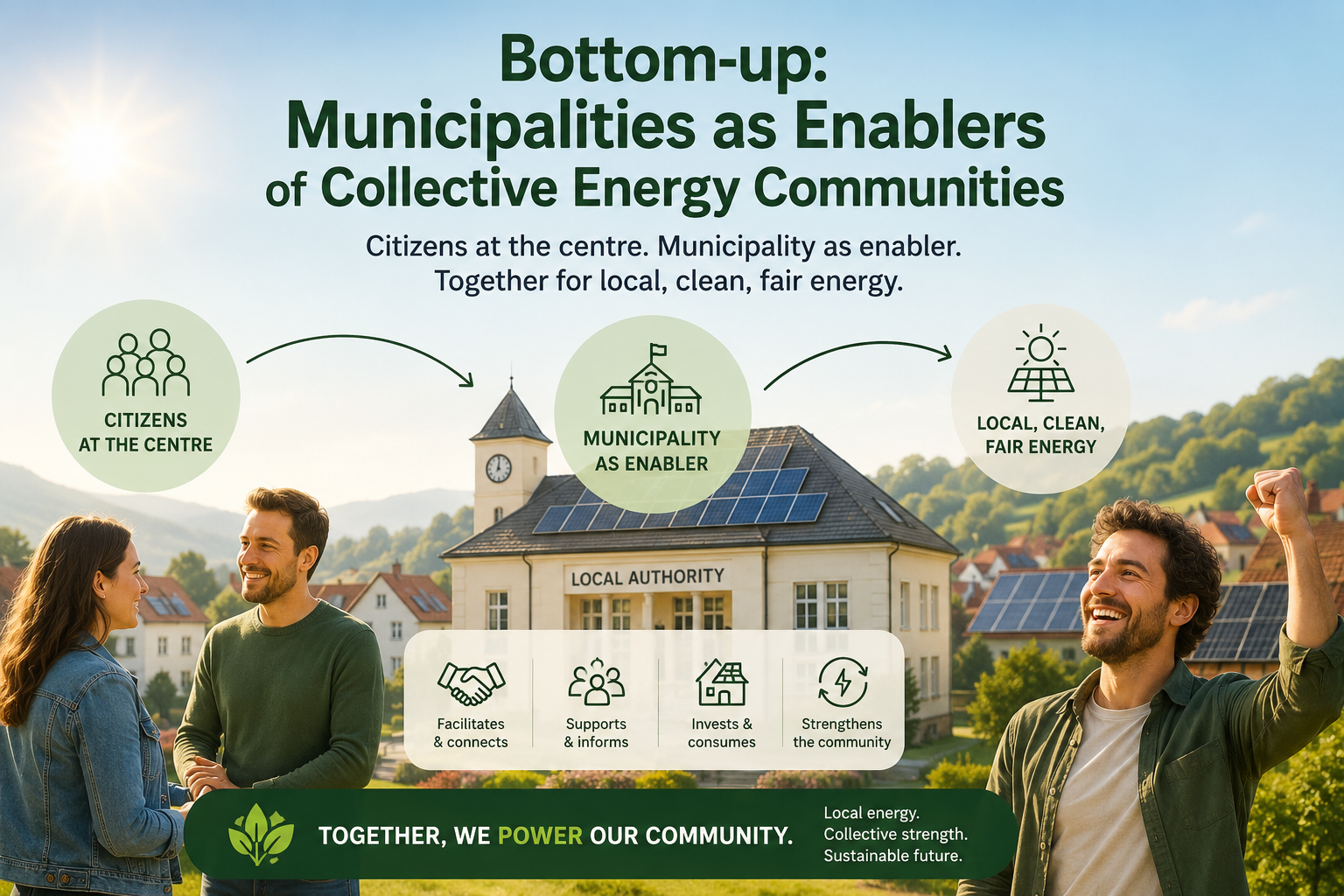
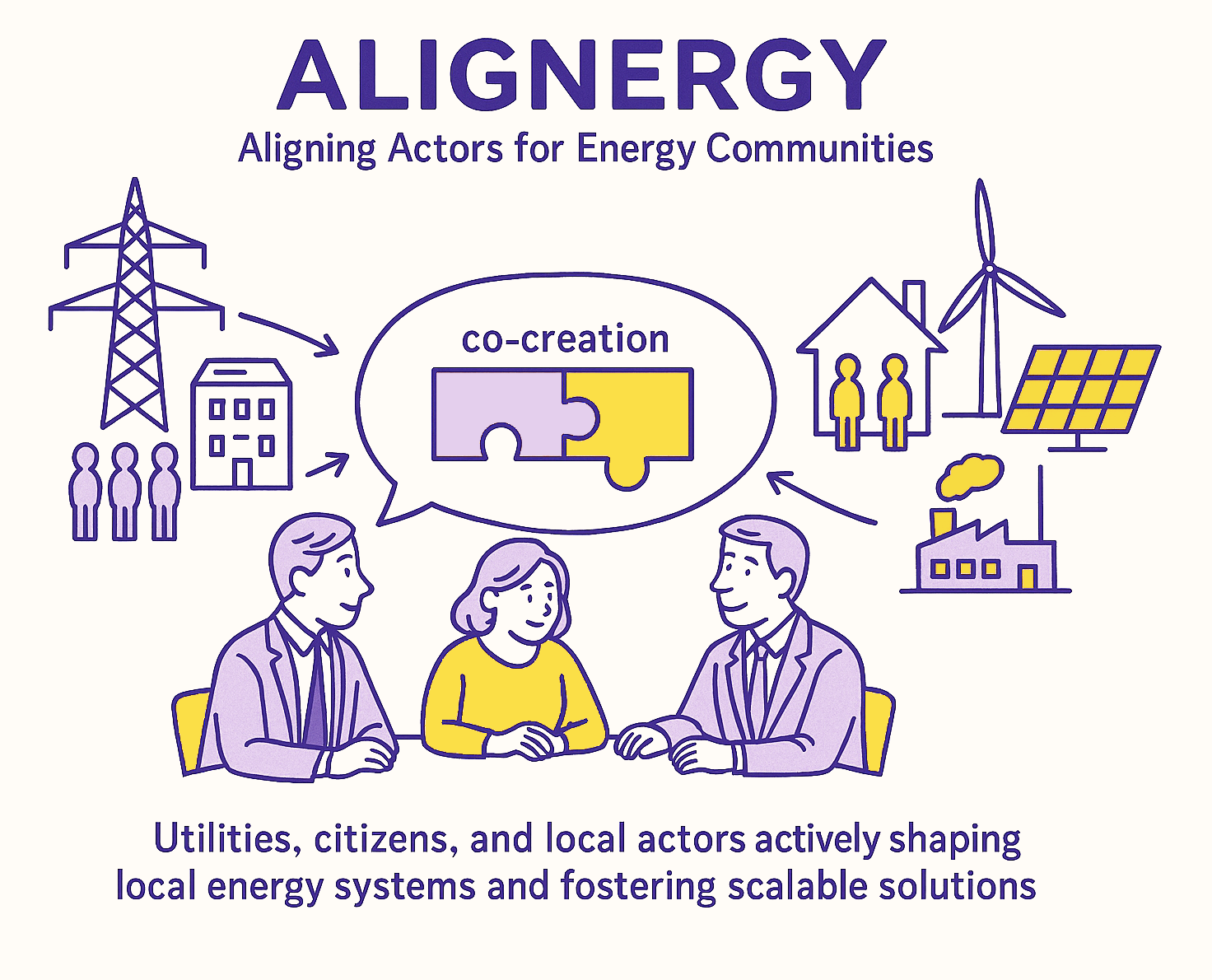
... clarify roles between municipalities, DSOs, citizens, cooperatives and private actors through standardised interface models and agreements – and build new partnerships?»
... reduce regulatory and administrative uncertainty that slows replication and undermines investability?»
... build national learning and umbrella structures that accelerate diffusion of energy communities ?»
... translate abstract goals like ‘decarbonisation’ or ‘grid flexibility’ into meaningful everyday practices that can be mainstreamed?»
... develop new professional roles such as neighbourhood energy managers?»
Switzerland is entering a new phase of the energy transition. With the adoption of the Electricity Act, local energy communities (LECs) have become possible in 2026. For the first time, locally produced renewable electricity can be shared within neighborhoods or municipalities via the public grid. This opens up a new opportunity for decentralized energy cooperation.
But this legal opportunity does not automatically lead to large-scale impact. Across Europe, many energy communities remain isolated pilot projects.
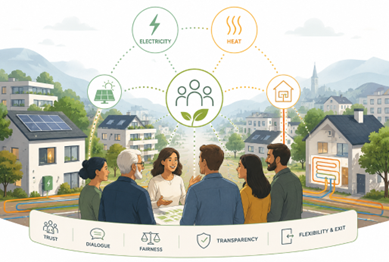
Energy communities are therefore not just technical infrastructures; they are also social innovations that redefine:
- who can participate in the energy transition,
- who benefits from renewable energy,
- who governs local energy systems,
- who bears the risks and responsibilities.
By energy communities, we mean both local energy communities (LECs) as defined for Switzerland by the Electricity Act, but also decentralized initiatives that build energy communities in a broader sense. This includes decentralized renewable energy production, and sector coupling, linking electricity with mobility, heating.
If designed well, energy communities can strengthen energy security, local value creation, and societal participation.
How could we unlock the structural conditions that would allow energy communities to develop on a national scale, thereby strengthening resilience, participation, and local value creation in Switzerland?
With this call for ideas, we are looking for social innovations to overcome the challenges and barriers - and support the development and scaling of energy communities in Switzerland.
Submit your ideaTimeline

The challenges within the FUS ‘Energy Communities’ mission seek to address the overarching FUS question: How will we live in urban Switzerland in the future?
We are looking for radical ideas to turn energy communities into reality in many locations. We are looking for processes, products, platforms, services or programmes that test new forms of shared responsibility and cooperation, or develop concrete solutions that embed energy communities as part of our energy infrastructure.
Through an open innovation process, we foster exchange between existing and planned energy communities and project developers, the interested public, as well as stakeholders from research and practice, planning authorities, politics and the investment sector.
In particular, we also invite cantonal, city and municipal administrations that wish to leverage energy to drive their climate and energy goals – or are already doing so. But researchers, pioneers and initiatives from niche sectors are also invited to contribute their knowledge and practical experience and to develop partnerships to scale up their approaches.
Join us and help spread social innovation around energy communities, and secure financial and methodological support as well as valuable contacts for the next steps within an interdisciplinary team!
What are we looking for?

We are looking for radical ideas to make the most promising social innovations acceptable to the wider public – by involving civil society, the business sector, public administration and/or politics. Are you working on relevant offerings, services, organisational structures, business and impact models, communication and intervention strategies, or strategic experiments?
We don't expect proof. We expect clarity about what needs to be tested — and what failure would reveal.
We don't select the most finished ideas. We select teams that understand the lever, know what they need to test, and have the potential to move something in the system.
We facilitate the conduct of feasibility, user or market studies, as well as the development of models and prototypes designed to illustrate and test potential solutions.
We look forward to receiving proposals that enhance and amplify the contribution of social innovations to a climate-just and liveable urban society of the future.
Who can apply?
In accordance with Innosuisse’s guidelines, only mixed teams comprising members from at least one research partner and one implementation partner may apply. The events organised during the Challenge Stage provide an opportunity for individual stakeholders to connect. If a project team is missing a partner, we can try to assist. Please contact matchmaking@futureurbansociety.ch for this or for other networking opportunities.
Research partners include university research institutes, non-commercial research centres outside the higher education sector, departmental research institutes with their own research projects, and federal research institutes.
Implementation partners are all private and public stakeholders who can put ideas into practice or at least play a part in doing so.
We can only award funding to legal entities – cooperatives, associations, foundations, companies, universities, local authorities, etc. – based in Switzerland.
How can the funds be used?
The funding can be used for feasibility, usage or market studies. Where possible and appropriate, funding is provided for the development of models and prototypes to illustrate and test potential solutions. The funds can be used flexibly as appropriate, e.g. to pay salaries, purchase equipment and materials, conduct observational and interview-based research, cover travel expenses, organise roundtables, workshops, etc.
The use and allocation of funds within the funded teams is therefore at their own discretion, but they remain accountable for their use.
A portion of the funds is reserved for content-related and methodological support from experts in the respective fields.
The total grant amounts to a maximum of CHF 22,500. Of this amount, CHF 19,000 is paid out directly. CHF 1,500 is earmarked for coaching and support from the FUS team over a six-month period. An additional CHF 2,000 is available for external experts, either from our pool of over 100 experts or chosen freely based on the project’s needs.
What needs to be submitted?
The application should ideally comprise 2–3 A4 pages in Arial 11 and should not exceed 5 pages.
Funding is available to anyone who has taken part in one of our open innovation events.
Judging criteria - how we select
Our jury evaluates every application across two dimensions.
What your idea could change carries the most weight. We look at whether your team has identified a real transformation barrier, not just a symptom. We look at whether your solution could create impact beyond your own project. And we look at whether you know what you need to find out, and show the willingness to change course if the results demand it.
Whether your team can do this is the second dimension. We assess whether your testing approach is realistic for the six-month booster, whether you have named the right partners to test with, and whether your team is well-positioned for this particular challenge.
We also look at the overall portfolio. A strong FUS cohort is not just a collection of good pilots — it includes projects that remove barriers for others, build shared infrastructure, or generate knowledge that advances the whole field.
Our criteria at a glance
Block A — Transformation potential (70%)
— Problem understanding and solution fit. Does the team understand a deeper, structural problem? And does their approach address it at the root?
— Impact potential. Could this change how the system works — beyond the lifetime of this project?
— Test logic and willingness to learn. Does the team know what it needs to find out? And does it show genuine openness to revising its assumptions?
Block B — Implementation capacity (30%)
— Testing approach and partnerships. Is the plan realistic for the booster phase? And have concrete test partners been identified?
— Team composition. Does the team have the right mix of competencies for this particular challenge?
We publish our criteria openly — not as a checklist to game, but because we believe better applications come from teams who understand what we are actually looking for.
Two brief notes on what this means in practice. First, we do not expect your idea to be fully formed. Early-stage ideas with a sharp problem diagnosis and a credible test plan are exactly what the booster is designed for. Second, naming a concrete test partner (at least identified) in your application is not a formality — it is one of the clearest signals that your idea is ready to leave the page.
If you have any questions, please check the FAQ first. If you still have questions after that, please feel free to contact us at info@futureurbansociety.ch
Jetzt Idee einreichenEvent
No further events are currently planned.