Short description
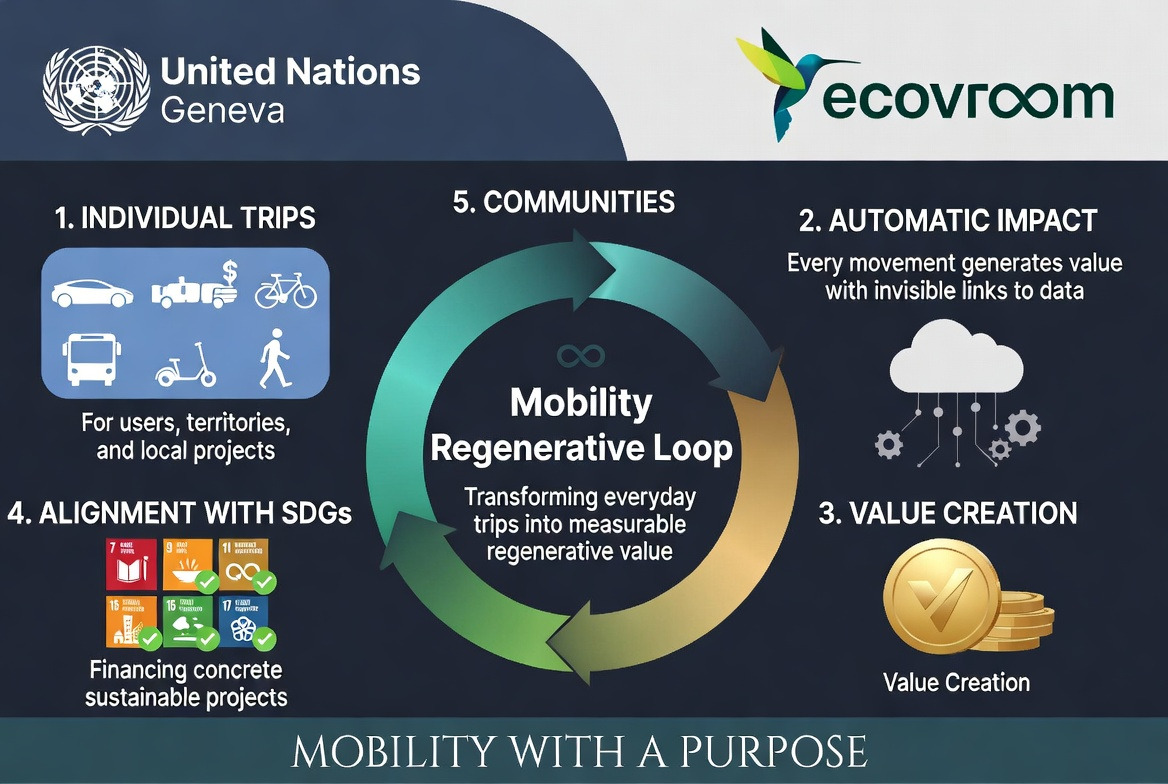
EcoVroom is a Swiss carpooling platform making commuting 100% free for passengers. Drivers are compensated through verified carbon credits and corporate CSR partnerships. Powered by the AI-driven VROOM algorithm, the project gamifies mobility with VroomPoints to reward sustainable behavior. Its mission is to reduce CO2 emissions and traffic by turning private cars into a shared, eco-friendly transport network.
Contact person for the project
EcoVroom
Raphael Gaxotte-Perrot
ecrovroom@proton.mr
Vernier
Detailed description
What deeper problem are you addressing?
EcoVroom addresses a deep-seated structural issue rather than just its visible symptoms. While road congestion and escalating CO2 emissions are the primary symptoms, the fundamental problem is the inefficient integration of private vehicles into the public transport network, particularly in peri-urban and rural areas where traditional public transit is often insufficient.
The project tackles several key structural barriers and systemic hypotheses as its starting point:
• Infrastructure and Coverage Gaps: A core hypothesis is that current public transport systems (like the TPG in Geneva) lack the flexibility to cover "last mile" needs or low-density zones, creating a forced dependency on individual car use.
• Economic Barriers to Sustainable Choice: Traditional carpooling platforms like BlaBlaCar or Uber often impose direct fees on users, which acts as a financial barrier to mass adoption. EcoVroom's systemic hypothesis is that a "zero-fee" model for passengers is necessary to achieve the critical mass required for a sustainable network.
• Mobility as a Cost vs. an Asset: Systemically, mobility is currently viewed as a cost for the individual and society. EcoVroom's approach is rooted in the hypothesis that mobility can be transformed into a measurable asset (a "carbon sink") by using AI and climate finance to monetize the CO2 avoided by shared rides.
• Fragmentation of Environmental Value: A fundamental barrier is that the environmental benefit of a carpooled trip has historically been disconnected from its economic value. The project addresses this by bridging carpooling with verified carbon credit markets (like the VCS standard), effectively turning every shared kilometer into a form of currency that supports the local economy.
Which habits or practices do you want to change — and how?
• The Habit of "Autosolisme" (driving alone) : The project identifies the habit of people driving alone as the "biggest challenge" and a major behavioral structural barrier. EcoVroom posits that moving beyond this requires more than just an idea; it requires a movement that connects with people on an emotional and aspirational level.
• To drive this social innovation, EcoVroom uses a multi-faceted approach:
• Removing Economic Barriers: The project transitions from standard transactional carpooling to a "zero-fee" model for passengers, ensuring that cost is never a barrier to choosing a shared ride over a solo one.
• Monetizing Sustainability: Rather than charging users, the approach relies on Verified Carbon Credits and CSR partnerships to compensate drivers. This transforms mobility from a societal cost into a measurable "carbon sink" and financial asset.
• Collaborative Gamification: Using VroomPoints ( our metric that’s back science approach), the platform rewards shared journeys and eco-friendly driving. These points are designed to be reinvested into the local economy through discounts at partner merchants, fostering a sense of community benefit.
• Emotional and Aspirational Connection: The approach moves beyond simple utility to touch people on an emotional level, framing carpooling as a collective movement for a sustainable future. This is embodied in the slogan: "Together, we go further".
• Technological Trust: The VROOM algorithm (Verified Register of Optimized Mobility) uses AI to provide efficient matching and transparent, ultra-precise CO2 measurement, ensuring the legitimacy of the environmental impact.
• By combining these elements, EcoVroom seeks to integrate private vehicles into a sustainable common transport system, turning every daily commute into an act of ecological and social value.
Who will benefit — and how could your idea create impact beyond this project?
EcoVroom is designed to provide immediate benefits to local stakeholders while creating a scalable blueprint for sustainable mobility that can be applied to other cities and sectors.
Direct Beneficiaries
• Passengers: They benefit from a 100% free carpooling service, removing financial barriers to shared transport, especially in peri-urban and rural areas poorly served by traditional networks.
• Drivers: Instead of paying for their own fuel and maintenance alone, drivers receive compensation through verified carbon credits and CSR partnerships, rewarding their eco-friendly behavior.
• Local Merchants: The local economy is stimulated as the VroomPoints earned by users are designed to be spent as discounts at partner shops within the Grand Geneva and Vaud regions.
• Companies and Corporations: Businesses can meet their CSR and ESG targets by sponsoring commutes or purchasing verified carbon units generated by the platform.
• The Environment and Public Health: The broader community benefits from a targeted reduction of 3,000 tons of CO2 in three years and decreased road congestion.
Impact Beyond the Project
• Scalability to Other Cities: While launching in Geneva, the model is structured for rapid expansion to other Swiss hubs like Lausanne and Zurich, and eventually across Europe.
• Improving Structural Conditions for Public Transport: EcoVroom serves as a "last mile" solution that integrates private vehicles into the existing transport infrastructure, complementing services like the TPG in areas where flexibility is currently lacking.
• A New Model for "Carbon Sink Mobility": The project introduces a systemic shift by treating mobility as a measurable asset rather than a cost, demonstrating how climate finance can fund essential social services.
• Fostering Prosocial Behavior: By incorporating gamification research, the project uses collaborative gamification to move away from competitive models, fostering a sense of social cohesion and collective mission that can be
Has the idea already been tested — and if so, what did you learn?
The idea behind EcoVroom has already been tested in an informal and manual way through an Excel spreadsheet and a WhatsApp group of around 30 people.
Here are the key insights and next steps drawn from these initial experiments:
• Concept validation: These tests confirmed that the carpooling concept works and responds to a real need.
• Need for technical infrastructure: To make the impact, particularly CO₂ reduction, measurable at scale and with precision, the use of a robust and automated platform has become a priority. This is essential to ensure transparency and data integrity required by carbon certification standards.
• Ambition for 2026: Building on these early results, the goal is now to launch the MVP (Minimum Viable Product) 2026. EcoVroom Light app.
• Current progress: A mockup already exists. The next step is to finalize the software development (coding phase) in order to launch a Proof of Concept (POC).
• Geographical focus: The project initially targets the city of Vernier for deployment. However, EcoVroom remains open to other municipalities and cantons to expand its sustainable shared mobility network.
In short, these manual tests have demonstrated the viability of the approach, and the project is now entering a phase of technological structuring, aiming to transform early experiments into a scalable mobility system with global impact.
What do you want to work on during the booster — and what do you want to find out?
During the booster, the primary objective is to transition from the current vision and documentation into a clear, realistic, and buildable roadmap for EcoVroom Light. This involves defining the core MVP functionalities, mapping efficient driver and passenger flows, and establishing the initial logic for the Smart Cities system. We plan to refine the technical architecture necessary for a pilot (POC) in the city of Vernier, focusing on proving the model in a real environment before scaling to the full infrastructure.
Through this process, we want to find out the precise data capture requirements for accurate impact metrics and obtain a realistic estimation of the time and cost for the first development phase. We also aim to identify and mitigate primary risks surrounding data privacy and emission verification.
Our most important assumptions that must be true for the project to succeed include:
Behavioral Shift: Drivers and passengers will move away from the habit of "autosolisme" (driving alone) when engaged through a gamified, community-driven movement.
Non-Monetary Compensation: Drivers will find the compensation via Verified Carbon Credits and CSR partnerships be a sufficient incentive.
B2B Viability: Corporate partners will pay for "VroomPoints" generated by their employees to fulfill their ESG/CSR quotas through our platform.
Technical Integrity: The VROOM algorithm can quantify avoided emissions with the ultra-precision required to meet international standards like Verra VCS.
We want to test the B2B "Terrain Elasticity" first. Confronting the model with real corporate CSR buyers to verify their willingness to pay for these credits. Simultaneously, we will conduct a "Legal Crash-test" to ensure the legality of emitting points linked to voluntary carbon markets. Proving this B2B pivot is considered the fundamental condition for the project's long-term viability.
EcoVroom relies on a strategic diversification of its revenue streams through a PPPP approach (Publi
What is your most important learning goal — and how would you know if you need to change course?
The most important learning goal for the EcoVroom project during the booster is to transition from a theoretical vision into a clear, realistic, and buildable roadmap for EcoVroom Light (the MVP) that can be validated in a real-world environment.
What needs to be found out during the booster
Based on the strategic audit of the project, we need to resolve three critical uncertainties:
1. B2B Terrain Elasticity: We must determine if corporate CSR buyers are willing to pay for the "VCU " generated by their employees to meet their ESG/CSR quotas, or if they prefer direct purchases on established platforms.
2. Legal Viability: We need to conduct a "Legal Crash-test" to confirm the legality of emitting VroomPoints as assets backed by voluntary carbon markets under Swiss regulations.
3. Data Precision: We must define the exact data capture requirements (telemetry via smartphones) needed to ensure the VROOM algorithm meets international certification standards (like Verra VCS) for proving additionality.
Knowing when to change course
Our strategy is rooted in the hypothesis that a B2B pivot is the only viable condition for the project's long-term survival, moving away from a traditional B2C transactional model.
We will fundamentally rethink our approach if the following specific results occur:
• On B2B Viability: If, after confronting the model with corporate stakeholders, we secure fewer than 3 formal Letters of Intent (LOI) from companies in the Geneva/Vernier region to pilot the system for their employees, we will fundamentally reconsider the B2B revenue engine and pivot back toward a model focused primarily on public subsidies (B2G).
• On Legal/Financial Structure: If the Legal Crash-test reveals that the VroomPoints system cannot be operated without a banking license or that it exposes the association to prohibitive VAT/fraud risks, we will fundamentally rethink our driver compensation mechanism to move away from "carbon currency" toward direct reward partnerships.
Who are your concrete test partners?
EcoVroom has identified and engaged with several concrete partners:
• OXÏ-ZEN: A strategic collaboration led by Raphaël Gaxotte-Perrot with Christopher Mbanefo, Founder and CEO: « The Art of Carbon Balance »
• Bumm Solutions: This organization is a key strategic partner that has already provided feedback on EcoVroom’s vision.
• Ville de Vernier and the Office Cantonal des Transports (OCT): These authorities are the primary targets for securing the local terrain for a Proof of Concept (POC). EcoVroom participated in a public mobility session at the École des Ranches on April 27, 2026. The current status involves joining the "groupe de suivi" (follow-up group) formed during that session to integrate EcoVroom into the commune's mobility plans and validate carbon-reduction data.
We are also seeking further support to find B2B corporate partners in the Geneva area to sign Letters of Intent (LOI), which is the fundamental condition identified by our strategic audit to prove the viability of our revenue engine.
What do you hope to get from the booster?
EcoVroom aims to secure the strategic support and connections needed to evolve from an informal pilot into a professionally structured, scalable mobility infrastructure.
Our primary expectations include:
• Governance structuring: Our non-profit association requires a solid and credible board to strengthen decision-making, legitimacy, and long-term vision.
• Connections to Strategic B2B Partners: We need support in building relationships with CSR and ESG departments of companies.
• Links to the Public Sector: We aim to deepen our engagement with the City of Vernier and the Cantonal Office of Transport (OCT). Our objective is to obtain official validation of our carbon-reduction data and integrate EcoVroom into the canton’s broader mobility strategy.
• Expert Knowledge and Legal Guidance: We are seeking specialized expertise to conduct a “legal crash test” in order to validate the regulatory framework for issuing VroomPoints as assets linked to voluntary carbon markets. In parallel, we need guidance to align our VROOM algorithm with international certification standards such as Verra VCS, ensuring the scientific robustness of our additionality claims.
• Access to a Testing Environment: The booster will provide the framework to launch our Proof of Concept (POC).
• Network Access
• Ultimately, we expect the booster to help refine our technical roadmap and business model, ensuring that the first version of “EcoVroom Light” is operational, legally sound, and attractive to institutional investors.
Who is on your team — and what is each person's or organisation's role?
The EcoVroom team is composed of a core group of founders and technical experts, supported by strategic organizational partners and advisors.
Core Management & Founders
• Raphaël Gaxotte-Perrot (Co-Founder & General Secretary ): Author of the original project idea. He provides the visionary leadership and strategic direction. His relevant experience includes administration at the UN (Brazilian mission), which provides the project with institutional rigor and access to international networks.
• Karen Gaxotte-Perrot (Co-Founder)
Technical & Specialist Support
• Gaurav Kumar : App developer
• Racha Gouareb (Consultant Data Scientist): AI expert
• Bumm Solutions / Lighthouse (Strategic Development Partners): Represented by Bernardo Bechini and his team (Matija, Martin, Urška), they act as strategic advisors.
• The Free Website Guys (Web Development): Led by Sven Nilsen, this team handles the WordPress/Astra customization of the project's landing page.
• Famba Luanga (Adviser & Technical Lead Consultant): Adviser at the Genese of the project
Institutional Access & Partnerships
• OXÏ-ZEN: A strategic collaboration led by Raphaël Gaxotte-Perrot with Christopher Mbanefo, Founder and CEO: « The Art of Carbon Balance »
• Geneva Forum: Through a GIP (Global Impact Project) Raphaël Gaxotte-Perrot works with this NGO.
• EcoBoost: Idea Incubator, with Lionel Lourdin acting as an external consultant for technical advice.
• LCPA : EcoVroom is engaged with these partners to secure locals partners in other countries after the Proof of Concept (POC). This team is part of the Expansion plan.
The project roadmap includes recruiting a Human Resources specialist, a Commercial lead, and an additional developer and digital marketing expert during the second year of operations to support national scaling.
Who do you need as an expert to further develop your idea?
Top Priority: Development
Before legal, before partnerships, before marketing…
If the product doesn’t exist, nothing exists.
We are already working with a developer in India. He needs a structured, paid collaboration.
• Unpaid developer → low priority, slow progress
• Paid developer → focus, accountability, real output
________________________________________
Strategic Priorities
1. Technical Development
• Pay our developer
• Build a functional POC
• Launch a pilot in Vernier
2. Legal (Second step)
• Validate VroomPoints framework
• Ensure data protection
3. Partnerships (B2B / Public)
• Companies (CSR/ESG)
• City of Vernier / public actors