Short description
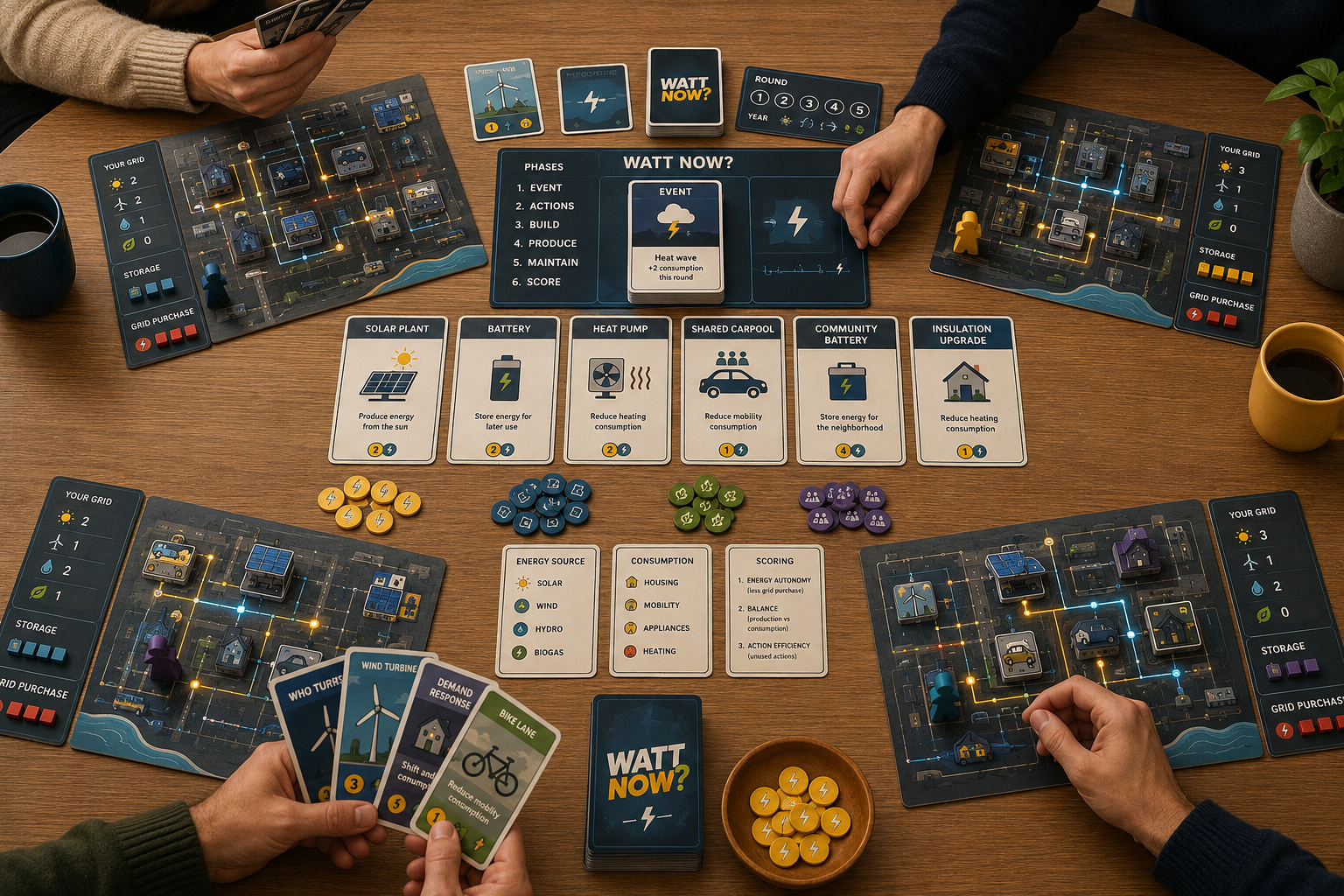
Watt Now? is a competitive board game where players build and manage neighbourhood energy systems. As consumption grows and unexpected events occur, players must increase local energy production, reduce consumption and invest in shared community solutions to reduce dependence on external energy. The game transforms abstract energy concepts into strategic decisions and explores how local energy communities can support more resilient neighbourhoods.
Contact person for the project
Energy Living Lab
Alexander Sokolov
alexander.sokolov@hevs.ch
Sion
Detailed description
What deeper problem are you addressing?
Local energy communities have the potential to increase citizen participation in the energy transition, but energy systems remain difficult for most people to understand. Concepts such as local production, energy autonomy or collective energy decisions often feel abstract and disconnected from everyday life. As a result, many people are expected to support or participate in energy initiatives without really understanding how they work. We believe this gap in understanding is one of the barriers slowing the wider adoption of local energy communities.
Attempts have been made to develop digital gaming solutions such as RECxploration and Gridly, however scenario based approaches are complex and are not accessible to a diverse range of consumers who are typically found in neighbourhoods.
Which habits or practices do you want to change — and how?
We want people to move from a passive relationship with energy to active contribution. Most people simply consume energy without thinking about where it comes from, how demand evolves, or how neighbourhood-level decisions can influence local energy independence. Through gameplay, players experiment with different strategies, discover trade-offs and explore how collective decisions can shape an energy community.
Who will benefit — and how could your idea create impact beyond this project?
The main beneficiaries are residents, new or prospective local energy communities (RCP, RCPv, CEL). New potential roles in the community such as neighbourhood energy managers supported by local energy delegates of the municipality could also benefit. The game offers a practical way to explore how neighbourhood energy systems function and how different decisions affect our everyday life and wider systems. Beyond this project, it could be used by schools, municipalities, energy providers and public engagement initiatives as an accessible introduction to local energy systems and community-based energy solutions.
Has the idea already been tested — and if so, what did you learn?
Although there are a large selection of serious games to engage people in the energy transition, so far in Switzerland there are no known card games co-created to build understanding of the specific models (RCP, RCPv, CEL). The concept for this card game has not yet been formally tested. It emerged from discussions around local energy communities and from reviewing existing educational and serious games for the broader energy transition. One observation is that many serious games are designed for workshops and are typically played once. This led us to explore a more competitive and replayable format that encourages people to return to the game, compare strategies and gradually build a better understanding of neighbourhood energy systems and have a transformative effect. Bringing people together in this way also helps to build social cohesion and inclusion, whereas digital games tend to be played in more isolated settings.
What do you want to work on during the booster — and what do you want to find out?
During the booster, we want to develop a playable prototype and organise several testing sessions with new or prospective local energy communities. We want to understand whether competition makes people more engaged, whether players develop a better understanding of local energy communities, energy systems, flexiblity and the potential for secondary effects, through gameplay, and how to make the game interesting over repeated sessions. We also want to explore whether players become more confident discussing neighbourhood energy solutions with others after playing. Our main assumption is that a hands-on strategy game can communicate these concepts more effectively than traditional participatory workshops or awareness sessions.
What is your most important learning goal — and how would you know if you need to change course?
Our most important learning goal is to understand whether the game successfully combines engagement and learning. If players enjoy the game but do not gain a better understanding of local energy communities, we would need to rethink the learning layer. If players learn something but are not interested in playing again, we would need to rethink the game mechanics. Both outcomes are necessary for the concept to work.
Who are your concrete test partners?
Through the Community of Practice on Sharing Renewable Energy (COPÉR) we have links to several new and prospective energy communities in Valais and Suisse Romande. Projects linked to the Energy Living Lab Assoication (ELLA) such as Play4Change will also be useful for identifying experts and test partners. Although we do not yet have confirmed testing partners, we have a network of intermediaries working with energy communities . Through COPÉR and IB FUS, we willidentify groups willing to test early prototypes and provide feedback on gameplay, learning outcomes and replayability.
What do you hope to get from the booster?
We hope to gain access to testing environments, pilot users and local energy communities willing to try early versions of the game. We are particularly interested in testing the concept with people involved in energy communities, as well as residents and community members who may have little prior knowledge of the topic. Most importantly, we want to understand whether the game is engaging, easy to understand and capable of stimulating discussion around local energy communities.
Who is on your team — and what is each person's or organisation's role?
Research partner: Energy Living Lab at HES-SO Valais Wallis. Alexander Sokolov. Architect with experience in workshops, educational activities and scenario design. Board game enthusiast responsible for concept development, game design, prototyping and testing.
Community of Practice on Sharing Renewable Energy (COPÉR) - match making with new and existing energy communities for testing.
Implementation Partner: Energy Living Lab Association - sharing experience of co-design and dissemination of serious games for the energy transition.
Who do you need as an expert to further develop your idea?
We are looking for technical, economic and social expertise in local energy communities, neighbourhood-scale energy systems and energy consumption patterns which we will identify mainly through COPÉR and HES-SO. Access to representative energy data would help us create realistic scenarios and game mechanics. Additional support in board game design and playtesting would help improve gameplay and replayability.