Short description
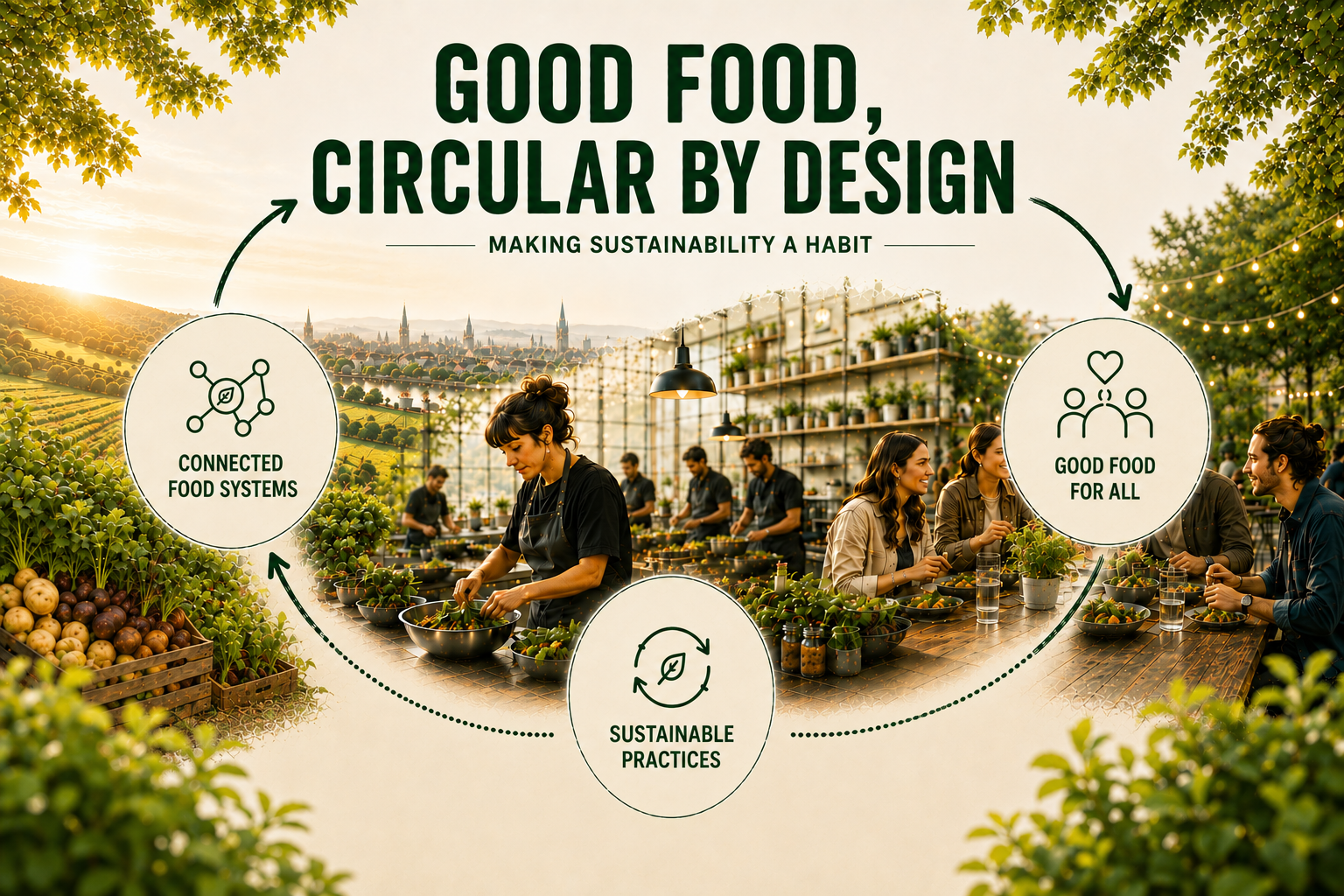
The Circular Gastronomy Lab explores how shared kitchens can evolve from production spaces into collaborative infrastructures for sustainable food systems. Through collective procurement, regional sourcing, circular production practices and food-waste reduction, sustainability is embedded directly into everyday operations. The project tests how shared infrastructure and coordination can make regionally sourced and sustainably produced food more practical, accessible and economically viable.
Contact person for the project
Verein Basel Food Factory
Savin, Vlad
hallo@foodfactorybasel.ch
Basel
Detailed description
What deeper problem are you addressing?
We address a structural gap between sustainability ambitions and the operational realities of food entrepreneurship. Many food startups, gastronomy actors and independent producers want to work more sustainably, but the environments in which they operate often make sustainable practices difficult, time-intensive and economically risky.
Current food systems are organised around convenience, standardisation and centralised procurement structures optimised for scale and predictability. Sustainable and regional alternatives often require additional coordination, unstable sourcing relationships and extra operational work that small food businesses cannot easily absorb in everyday operations.
One concrete consequence is the weak integration between regional producers and urban food businesses. Although regional products exist, they rarely enter gastronomy in forms compatible with professional kitchen workflows regarding delivery rhythms, processing, storage, continuity of supply or pricing structures. As a result, collaborative procurement potential, shared logistics and more regionally integrated sourcing practices remain underdeveloped. Regional food therefore struggles to become a convenient, economically viable and accessible everyday option for both food businesses and consumers.
The project also responds to the broader challenge of how good food can become more affordable and accessible beyond premium niches by redesigning operational infrastructures, collaborative procurement and regional coordination systems around shared models.
Our hypothesis is that sustainable transformation can be accelerated not only through new products, but through new operational infrastructures and coordination models. Shared kitchens are approached not simply as production spaces, but as collaborative infrastructures that enable coordination, experimentation and operational innovation around sustainable sourcing, circular production and regional food integration. The innovative aspect o
Which habits or practices do you want to change — and how?
We want to show that sustainable and regional food does not have to be complicated. By reducing barriers for food entrepreneurs and making good food more accessible to consumers, we aim to make sustainable food the easy choice.
Today, sourcing regional products, reducing food waste or implementing circular production practices often means more time pressure, fragmented procurement, unstable logistics and higher operational burdens. Sustainable choices therefore remain difficult to integrate into everyday kitchen realities.
Our approach follows the logic of the call: make sustainable food easier to produce, and make everyday food systems more sustainable. The project explores how shared kitchens can support collective procurement, regional sourcing coordination, shared logistics, circular ingredient flows and food-waste reduction directly within daily operations.
This changes practices on several levels: food entrepreneurs gain access to enabling structures that make sustainable operations easier to implement; regional producers benefit from stronger integration into gastronomy workflows; and consumers gain better access to regionally sourced and sustainably produced food through gastronomy, catering and food initiatives.
Rather than relying mainly on awareness or individual motivation, the project focuses on redesigning operational conditions so that sustainable and circular practices become easier, more economically viable and more normal within everyday food production environments.
The project therefore approaches sustainability not primarily as a consumer choice, but as an infrastructural and coordination challenge embedded within daily food production operations.
Who will benefit — and how could your idea create impact beyond this project?
Food entrepreneurs benefit through access to shared infrastructure, collective procurement systems, regional sourcing networks and collaborative operational practices that reduce coordination burdens and support more sustainable forms of food production.
Regional producers and processors benefit from stronger and more stable connections to gastronomy actors through coordinated sourcing structures, shared logistics and collaborative distribution approaches. The project supports more regionally integrated food relationships and shorter supply chains.
Consumers benefit through greater access to regionally sourced, sustainably produced and convenient food offerings across gastronomy, catering, markets and events. By improving operational coordination and accessibility, the project aims to make sustainable food less of a niche or premium option and more readily available in people's everyday food choices.
Beyond the project itself, the Circular Gastronomy Lab aims to develop a transferable model for how shared kitchens can function as collaborative infrastructures for circular gastronomy and sustainable food-system transformation. During the booster, we want not only to test interventions, but also to document how coordination, shared infrastructure and operational collaboration can support long-term behavioural and systemic change across regional food systems.
Has the idea already been tested — and if so, what did you learn?
Elements of the idea have already been tested through Basel Food Factory and the Shared Kitchen Project, where food entrepreneurs, regional producers and ecosystem partners collaborate through production activities, workshops, events and sustainability-oriented initiatives.
These experiences showed that many food entrepreneurs are motivated to work more sustainably, but often face structural barriers such as sourcing complexity, fragmented logistics, centralised procurement systems and the difficulty of integrating regional and circular practices into everyday kitchen workflows.
Initial experiments involving regional sourcing initiatives, collaborative production formats and food-waste reduction activities demonstrated the importance of shared infrastructure, coordination and collaborative operational environments in enabling more sustainable practices.
A key learning was that sustainable behaviour is more likely to emerge when sustainability is embedded directly into operational routines rather than added as an additional layer of responsibility. Another important learning was that small operational changes can create significant impact when supported through shared logistics, collective procurement and stronger coordination between producers and food businesses.
The experiments also highlighted that operational convenience and accessibility strongly shape food-related decisions, often more than sustainability awareness alone. This reinforced the importance of redesigning food infrastructures and coordination systems rather than relying solely on behavioural change at the individual level.
The project builds on these experiences by developing a more structured experimentation process focused on identifying which infrastructural and organisational mechanisms most effectively support sustainable and circular practices within everyday food operations.
What do you want to work on during the booster — and what do you want to find out?
During the booster, we want to test how shared kitchens can function as infrastructures for circular gastronomy and sustainable food-system production.
The project will test several practical intervention areas:
* collective procurement systems;
* regional sourcing coordination;
* shared logistics and processing structures;
* circular ingredient flows;
* food-waste reduction mechanisms;
* sustainability-linked market access;
* collaborative coordination between producers, processors and food businesses.
We want to identify which operational structures most effectively support the integration of sustainable and regional practices into everyday food production.
The key assumptions are: food entrepreneurs are willing to participate in shared sustainability-oriented systems if operational burdens are reduced; regional producers are interested in stronger integration into gastronomy networks; shared kitchen infrastructures can support collaborative coordination; and sustainably and regionally sourced food becomes more accessible when supported through operational and infrastructural innovation rather than individual effort alone.
What is your most important learning goal — and how would you know if you need to change course?
The most important learning goal is to understand which infrastructural, organisational and behavioural mechanisms can realistically support sustainable and circular practices within everyday food entrepreneurship without creating additional operational complexity or economic pressure.
We want to understand whether shared infrastructure, procurement coordination and collaborative operational models can make regionally sourced and sustainably produced food more practical, accessible and economically viable within everyday food production and consumption contexts.
We would reconsider our approach if food entrepreneurs consistently perceive regional sourcing, collective procurement or circular practices as operationally impractical despite facilitation and infrastructural support; if collaborative coordination between ecosystem actors remains low despite active support structures; or if the tested mechanisms fail to generate recurring participation and operational value within everyday kitchen realities.
The project therefore follows an iterative and experimentation-based approach focused on real operational testing, observation and continuous learning.
Who are your concrete test partners?
Verein Basel Food Factory: shared kitchen infrastructure, operational testing environment and ecosystem coordination; status: confirmed.
Institute for Management, FHNW: research and methodological support for experimentation and evaluation; status: confirmed.
Genossenschaft Lebensmittel Netzwerk Basel: regional sourcing coordination, producer networks and ecosystem collaboration; status: confirmed.
Regional producers, gastronomy actors and food entrepreneurs connected through Basel Food Factory and Lebensmittel Netzwerk Basel: testing of sourcing coordination, collaborative logistics and circular production practices; status: ongoing collaboration.
What do you hope to get from the booster?
We hope the booster will help us transform existing experimentation and partnerships into a more robust and transferable operational model for circular gastronomy and sustainable food-system coordination.
We are particularly looking for:
* expertise on collaborative infrastructure and governance models;
* support regarding sustainable procurement and regional sourcing systems;
* exchange with other Good Food for All projects;
* access to relevant sustainability and gastronomy networks;
* visibility and critical sparring;
* support in refining experimentation and evaluation methodologies.
For us, the booster is above all a learning and experimentation space to explore how sustainability can become embedded into operational food systems through shared infrastructure, collaboration and regional coordination.
Who is on your team — and what is each person's or organisation's role?
Vlad Savin (Basel Food Factory): project coordination, ecosystem development and operational implementation within the shared kitchen environment.
Christoph Schön (Basel Food Factory): strategic development, organisational coordination and integration into the broader food entrepreneurship ecosystem.
Thomas Keller (Basel Food Factory): infrastructure development and partnership building.
Michael von Kutzschenbach & Ananda Wyss (Institute for Management, FHNW): research and methodological support, experimentation framework and systems-oriented evaluation.
Felicia Schäfer (Lebensmittel Netzwerk Basel): regional sourcing coordination, producer networks and ecosystem support.
Together, the consortium connects shared infrastructure, research, regional sourcing networks, food entrepreneurship and operational experimentation.
Who do you need as an expert to further develop your idea?
We are looking for additional expertise in:
* circular gastronomy and sustainable food systems;
* governance and operational models for collaborative infrastructure;
* regional sourcing and sustainable procurement systems;
* behavioural and organisational change within food operations;
* experimentation and living-lab methodologies;
* impact assessment and scaling of collaborative food-system interventions.
We would also benefit from exchange with practitioners and organisations working on regenerative food systems, shared food infrastructures and sustainability-oriented gastronomy innovation.