Short description
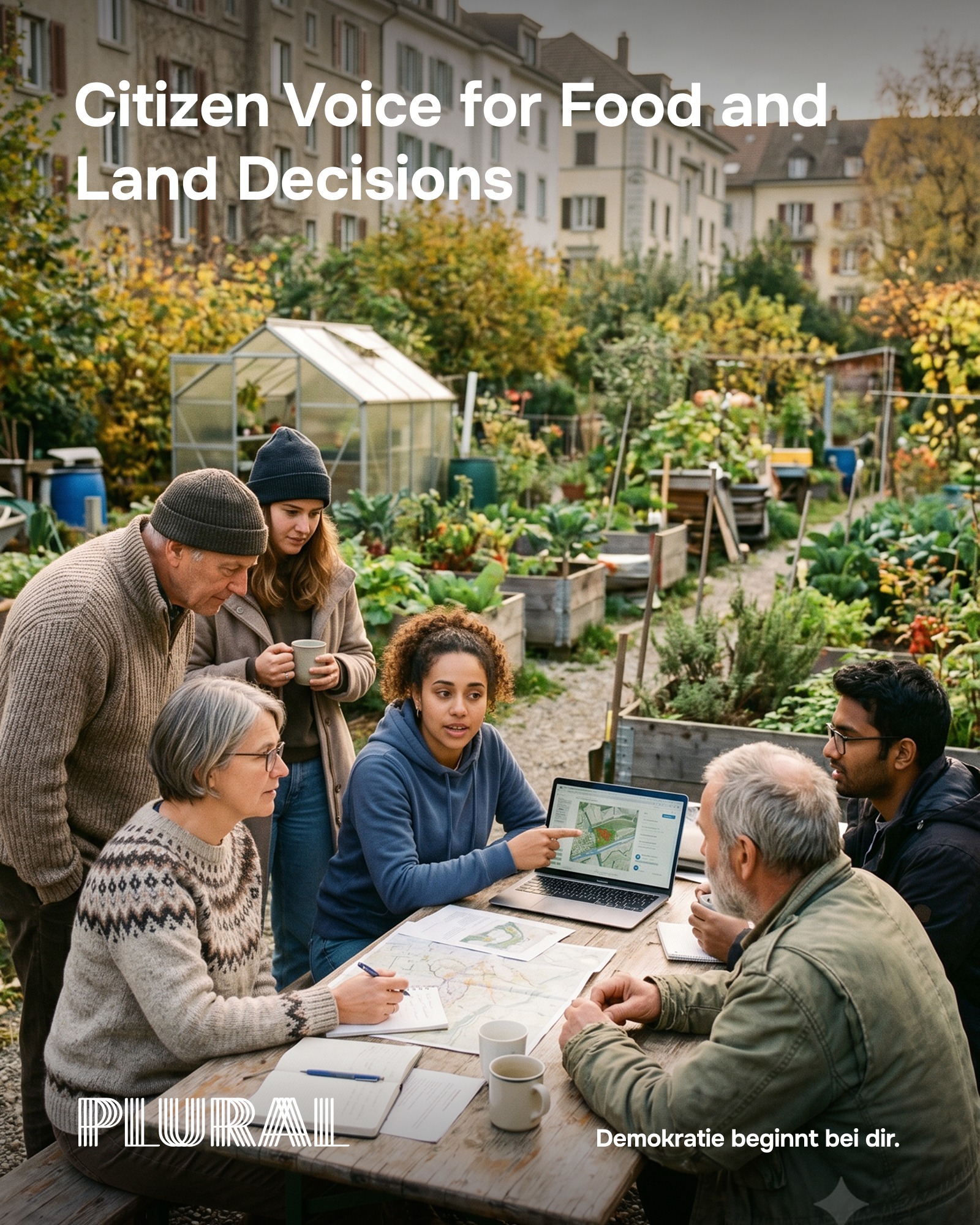
Plural is a Swiss civic-tech platform that enables neighborhoods and local communities to collectively develop and submit binding political proposals. We want to pilot Plural as the structured process layer for community decision-making on land use and food production, combining digital deliberation with physical formats. The goal: transform diffuse local concerns about food and land into concrete, politically actionable proposals.
Contact person for the project
Plural AG
Lanz, Maurice
maurice@plural.ch
Zurich
Detailed description
What deeper problem are you addressing?
Decisions about land use and food production formally involve communities (through planning processes, public consultations, and referendums) but in practice these mechanisms are too technical, too fragmented, and too late in the process for meaningful collective input. Neighborhoods have concerns and ideas, but no structured channel to develop them into coherent proposals that actually enter the political system. The result is a governance gap: land and food are treated as commons in rhetoric, but managed without the communities they affect. Plural addresses this structural gap directly.
Which habits or practices do you want to change — and how?
We want to shift how local communities engage with land and food decisions: from reactive (responding to top-down consultations, signing petitions, attending one-off public meetings) to proactive and structured (collectively developing proposals through a guided process that ends in a formal political submission). Plural's three-phase process (ideation, guided synthesis, political submission) provides the format. A hybrid approach combining the digital platform with facilitated in-person sessions in neighborhoods lowers the barrier for communities who are not primarily online and builds the social trust that pure digital tools cannot replace.
Who will benefit — and how could your idea create impact beyond this project?
Direct beneficiaries are residents of neighborhoods and local communities who want to influence decisions about land use and food production in their area but currently have no structured pathway to do so. Beyond this project, the process model is replicable for any community-level food or land governance question across Swiss cantons and municipalities. Political actors benefit too: they receive deliberated, community-backed proposals rather than diffuse pressure or fragmented individual feedback, which makes it easier and more legitimate to act on them. Municipalities looking to move toward participatory governance of food systems gain a ready-made tool.
Has the idea already been tested — and if so, what did you learn?
Plural is live and running two end-to-end pilot initiatives: one on meat subsidy reform and one on cantonal early childhood education. We have built and are actively testing the deliberation wizard, synthesis functionality, and political submission flow. Key learning so far: structured process design significantly lowers the threshold for participation compared to open forums. Participants engage more substantively when guided through defined positions than when asked for free-form input. The physical-digital hybrid dimension is the next layer we want to test. We have not yet combined in-person community sessions with the digital process, and this booster would be the first opportunity to do so.
What do you want to work on during the booster — and what do you want to find out?
We want to run the full Plural process with at least one concrete neighborhood or local community on a land use or food production question, ending in a formal political submission. Core assumptions to test: (1) Does a hybrid format (facilitated neighborhood sessions feeding into the digital deliberation platform) produce stronger participation and more representative proposals than a purely digital process? (2) Does the output, a structured community-backed proposal, gain traction with local political actors?
A central part of the booster will be documenting this process through a community portrait: a short, human-centered account of who participated, what they deliberated on, and how the experience changed their relationship to local politics and food governance. Inspired by the documentary approach used by some of the most effective civic and environmental campaigns, we want to show not just the political output but the human story behind it. What does it mean for a neighborhood to collectively author a proposal about land and food? What shifts in the relationship between citizens and political institutions when the process is structured, inclusive, and transparent? This portrait will serve both as evidence of impact and as a tool to communicate the model to other communities, municipalities, and funders.
During the booster we will develop the hybrid format, recruit a pilot community through regional partners, run the deliberation process, prepare the political submission, and produce the community portrait.
What is your most important learning goal — and how would you know if you need to change course?
Key question: Does the hybrid format produce proposals that are both representative of the community and politically actionable? Failure signal on the community side: fewer than 30 participants complete the full deliberation process, suggesting the format is not accessible enough. Failure signal on the political side: no local political actor is willing to formally submit or support the resulting proposal. Either outcome would require us to fundamentally rethink either the facilitation model or the political uptake strategy before scaling.
Who are your concrete test partners?
We are in early-stage contact with Gustavo Umbellino at the University of Zurich / Zentrum für Demokratie Aarau, whose research focus on democratic participation makes him a strong candidate for the research partner role. For the pilot community, we are exploring partnerships with neighborhood organizations and local food initiatives in the Zurich area. For political uptake, we have early-stage contact with cantonal and municipal political actors in Zurich who have expressed interest in structured citizen participation formats.
What do you hope to get from the booster?
(1) A confirmed research partner with expertise in participatory governance, deliberative democracy, or urban food systems. (2) Connections to neighborhood organizations, community food initiatives, or municipal bodies in the Zurich area that could serve as pilot partners. (3) Expert knowledge on Swiss land use governance and community participation mechanisms to strengthen the deliberation content layer.
Who is on your team — and what is each person's or organisation's role?
Maurice Lanz (CEO, co-founder): external communications, partnerships, financing, process design. Oliver Herren (co-founder): strategic leadership, political networks. Kevin Luginbühl (co-founder): product and UX. Marco Huber (senior designer): visual design and user experience. Andres Villa Torres and Jacopo Rodighiero (senior developers): platform development. The team has been building and running Plural full-time since founding. We bring an operational platform, two live pilot initiatives, and established relationships with Swiss political actors and civic organizations.
Who do you need as an expert to further develop your idea?
A researcher or policy specialist with knowledge of participatory land use governance, Swiss municipal food systems, or deliberative democracy methodology, to strengthen the deliberation content and validate the political framing of community proposals.