Short description
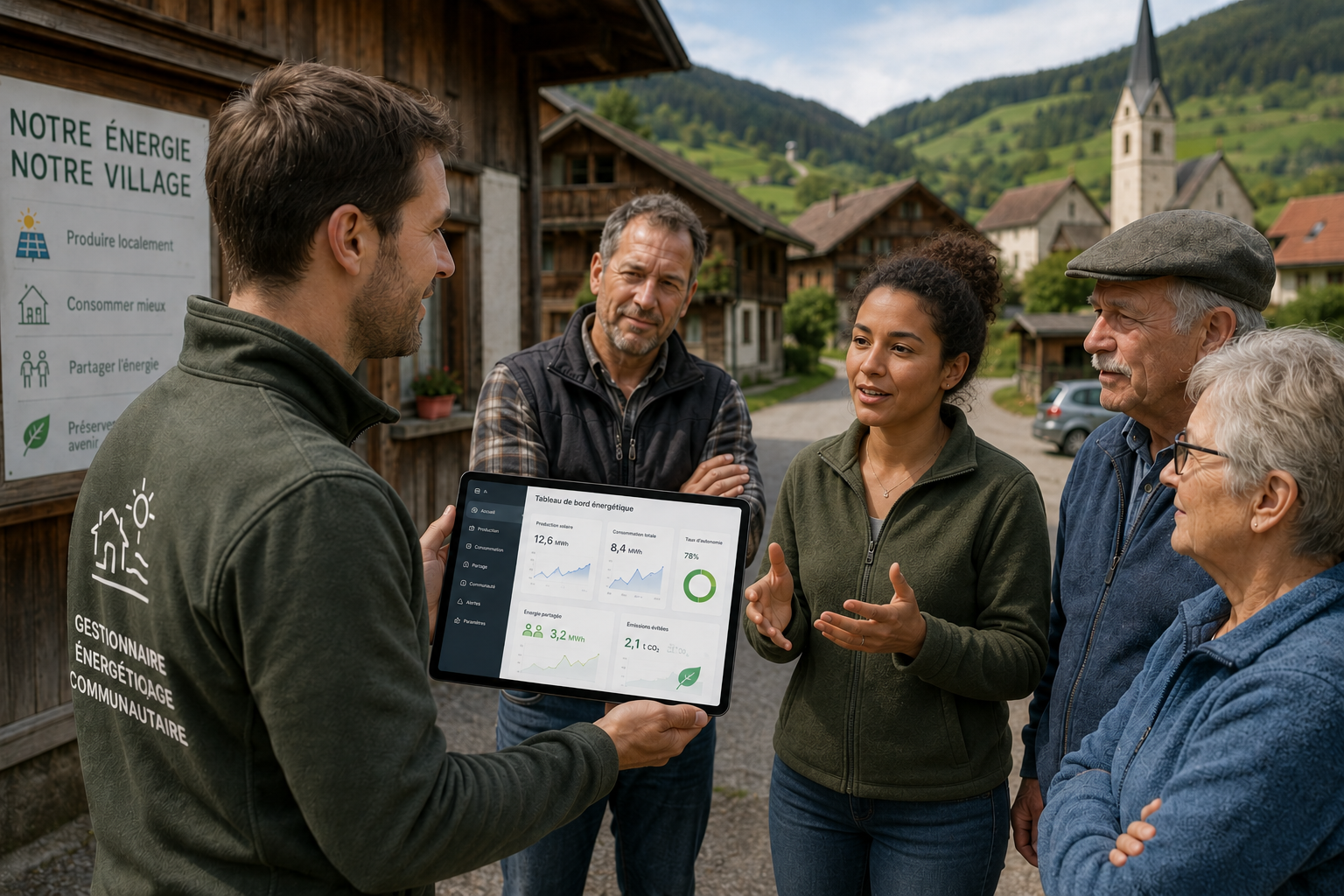
GovLab develops and tests a scalable governance model for Swiss energy communities by institutionalizing a new role: the "Community Energy Steward". We propose a two-tier structure where a sovereign, open-source digital platform managed by a central association supports autonomous local communities. Each community recruits its own Steward, trained and certified by the central structure, to bridge the gap between technical infrastructure and social adoption.
Contact person for the project
Modener Association
Jordan Romain
romain.jordan@modener.ch
Evionnaz
Detailed description
What deeper problem are you addressing?
While the new Electricity Act (2026) legally enables Local Energy Communities (LECs), a critical structural barrier remains: the human governance gap. Currently, launching an LEC relies heavily on volunteer enthusiasm or expensive external consultants. This will probably lead to projects that either never start due to administrative complexity, or they remain isolated initiatives dependent on a few overburdened individuals.
Consequently, three systemic issues arise:
1. Exclusion: Tenants, low-income households, and non-tech-savvy citizens are de facto excluded because there is no trusted local intermediary to guide them.
2. Fragility: Communities collapse if the key volunteer leaves, lacking professional continuity.
3. Non-Replicability: The lack of a standardized operational role prevents scaling beyond early adopters.
We address the hypothesis that energy communities cannot scale nationally without the local management layer. The technology exists; the missing link is a dedicated, trained human role that bridges the gap between complex regulations/technical tools and the daily reality of residents. Without this "social infrastructure," the legal framework alone will not achieve the intended energy transition targets.
Which habits or practices do you want to change — and how?
We aim to fundamentally shift energy community management from a voluntary, ad-hoc activity to a recognized local profession. Currently, residents face a "participation barrier": they either remain passive consumers or must become amateur energy experts to join a community. This reliance on unpaid volunteers creates fragility and excludes those without time or technical skills.
We propose replacing this fragile volunteer model with a professional "Community Energy Steward" embedded in each neighborhood. In addition, we want to develop a central platform to support and assist stewards in their work. This changes daily practices in three ways:
- From passive to guided participation: Instead of navigating complex regulations alone, residents interact with a trusted, trained local expert who simplifies decisions and ensures inclusive access for tenants and low-income households.
- From fragmented to standardized governance: We replace isolated, reinvented-by-each-project rules with a replicable framework. A central non-profit entity (Modener Association) provides the legal backbone, digital tools, and certified training, while local communities retain autonomy over their specific energy choices.
- From technical burden to social facilitation: The Steward's role is not just technical; it is social. They facilitate democratic decision-making, manage administrative compliance, and animate the community, turning energy sharing into a tangible social link rather than a bureaucratic hurdle.
Our Approach:
- Co-create the role: Define the Steward's profile, training curriculum, and legal status through Living Lab workshops with future stewards, residents, and legal experts.
- Empower via tools: Develop digital governance tools (open source) that allow Stewards to manage communities efficiently without needing deep technical expertise.
- Validate the economic model: Test a remuneration scheme where the community pays the Steward from generated savings, creating a sustain
Who will benefit — and how could your idea create impact beyond this project?
Direct Beneficiaries:
- Residents: They gain barrier-free access to renewable energy benefits without needing technical expertise. A trusted local Steward ensures inclusive pricing and active participation, turning them from passive consumers into empowered "energy citizens."
- Local workforce: The project creates new, non-relocatable green jobs. Local individuals (existing community members or job-seekers) are trained and employed as Stewards, keeping value creation within the neighborhood.
- Municipalities and grid operators (DSOs): They gain a single, professional interlocutor per community, drastically reducing administrative friction. This accelerates permit processing, improves grid coordination, and ensures compliance with OApEI 2026 regulations.
Systemic impact (beyond the pilot):
- A national standard, not fragmented solutions: By establishing Modener as the single national reference for energy community governance and platform development, we prevent costly fragmentation where every canton reinvents its own wheel. This centralization ensures financial maintainability, consistent legal compliance (OApEI 2026), and a unified user experience across Switzerland, allowing best practices to scale instantly.
- Open source as a sovereignty guarantee: The platform’s core code will be open source, not to encourage fragmentation, but to ensure long-term data sovereignty and continuity. This guarantees that communities are never locked into a proprietary vendor: if the operational entity changes, the tools and data remain accessible. This builds essential trust with public partners while positioning Modener as the certified provider of updates, security, and support.
- A replicable model: We provide a validated blueprint (steward role + governance framework) that any community can adopt immediately. By transforming isolated pilots into a standardized, service-ready infrastructure, we lower the entry barrier for nationwide deployment and accelerate the energy tran
Has the idea already been tested — and if so, what did you learn?
The technical and legal foundations of the project have been established. The governance model has been designed to strictly comply with the new OApEI 2026 regulations regarding Local Energy Communities. Furthermore, the core platform structure (based on Frappe/ERPNext) has been defined and is ready for specific module development.
However, the integrated socio-economic model—specifically the "Community Steward" role and its financing by local members—has not yet been tested in the field.
This booster is therefore essential to move from a theoretical design to an empirical validation. We will not just build a tool; we will test the fundamental assumption that professionalizing local governance is the key to scaling energy communities nationwide.
What do you want to work on during the booster — and what do you want to find out?
During the 6-month booster, we will focus on defining the structural conditions for the "Community Steward" role and validating the governance model through our Living Lab partnership (Energy Living Lab @HES-SO):
WP1 : Co-define the steward profile and framework:
- T1.1 (ELL) : Conduct participatory workshops to outline the core competencies, mission scope, and optimal legal status (freelance, employee, or cooperative member) for the Steward.
- T1.2 (Modener) : Draft a legally valid contract template.
WP2 : Prototype the governance tools:
- T2.1 (Modener) : Develop the core "Community Management" module on the platform (Frappe/ERPNext), enabling basic democratic functions (voting, transparent communication) and administrative tracking needed for a Steward to operate.
WP3 : Validate acceptability and identify barriers:
- T3.1 (ELL) : Conduct structured interviews and polls with key stakeholders (municipal energy officers, existing communities, housing association reps) using the drafted contracts and tool prototypes to uncover practical deal-breakers (e.g., liability fears, mistrust of central authority, confusion over roles) before any real-world deployment.
- T3.2 (Modener) : Test the platform in two existing energy communities (Evionnaz and Autigny).
Key hypotheses to test:
- Feasibility hypothesis: A clear legal status and standardized training can be defined for the Steward role within the current Swiss regulatory framework (OApEI, Labor Law).
- Governance fit hypothesis: The proposed model (central non-profit providing tools/training + local community retaining autonomy) is legally robust and socially acceptable to both municipalities and residents.
What is your most important learning goal — and how would you know if you need to change course?
Our most important learning goal is to identify the minimum viable conditions (legal status, cost, governance) for the "Community Steward" role to exist in Switzerland. We need to confirm two things:
1. Is it legally possible to create this role without excessive liability?
2. Is it socially accepted by communities to pay for a local professional?
Triggers for a change of course:
- If the cost is rejected: If stakeholders clearly state they cannot or will not fund a local Steward, we will pivot immediately to a certified volunteer model with reduced scope.
- If the legal status is blocked: If Swiss labor law makes a local employment contract too risky or complex, we will pivot to a centralized service model where the central entity employs the Stewards and "leases" them to communities.
- If the governance is too complex: If users cannot understand or manage the proposed two-tier structure during workshops, we will simplify the solution to a basic toolkit for existing associations, postponing the ambitious governance reform.
Who are your concrete test partners?
Energy Living Lab @HES-SO (research partner): Will lead the Living Lab methodology, orchestrate workshops, and validate the social impact scientifically.
Association Suisse pour l’Énergie Citoyenne (ASEC): The association will participate to the co-creation phase by involving different members (existing communities, cooperatives, ...). Potential partners interested in testing the platform may also be contacted via the association.
Local communities: The energy communities of Evionnaz and Autigny will be our main testing partners for the platform. We also have the potential to work with partners such as housing associations through Ville de Sion and the Commune of Gryon.
What do you hope to get from the booster?
We seek to leverage the Innovation Booster to secure specialized legal expertise in labor and cooperative law, which is essential for definitively mapping the legal status of the "Community Energy Steward" and establishing a liability framework that protects both individuals and the central structure. Simultaneously, we aim to integrate the Energy Living Lab @HES-SO’s methodology to design robust co-creation workshops and surveys, ensuring we gather unbiased data on stakeholder needs and adoption barriers. Ultimately, the credibility and visibility conferred by the FUS label will validate our approach as a serious national innovation, enabling us to attract future Steward candidates and institutional partners critical for the post-booster nationwide deployment of our governance model.
Who is on your team — and what is each person's or organisation's role?
- Romain Jordan (Modener Association / implementation partner): Project lead and implementation partner. Expert in energy solutions and full-stack development. Responsible for the legal framework design, platform prototyping, and overall project coordination.
- Fiona Zimmermann (Energy Living Lab / research partner): Research lead. Expert in living lab methodologies, social innovation, and participatory design. Responsible for orchestrating stakeholder workshops and validating the steward profile and his social acceptability.
Who do you need as an expert to further develop your idea?
We will need a law expert to define the optimal employment contract status for Community Stewards and draft the liability clauses between the central entity, the Steward, and the local community. The Community of Practice for Sharing Renewable Energy (COPER) have engaged a legal expert and our project will be presented as a case study to work on in advance of the legal workshop on November 13th.