Short description
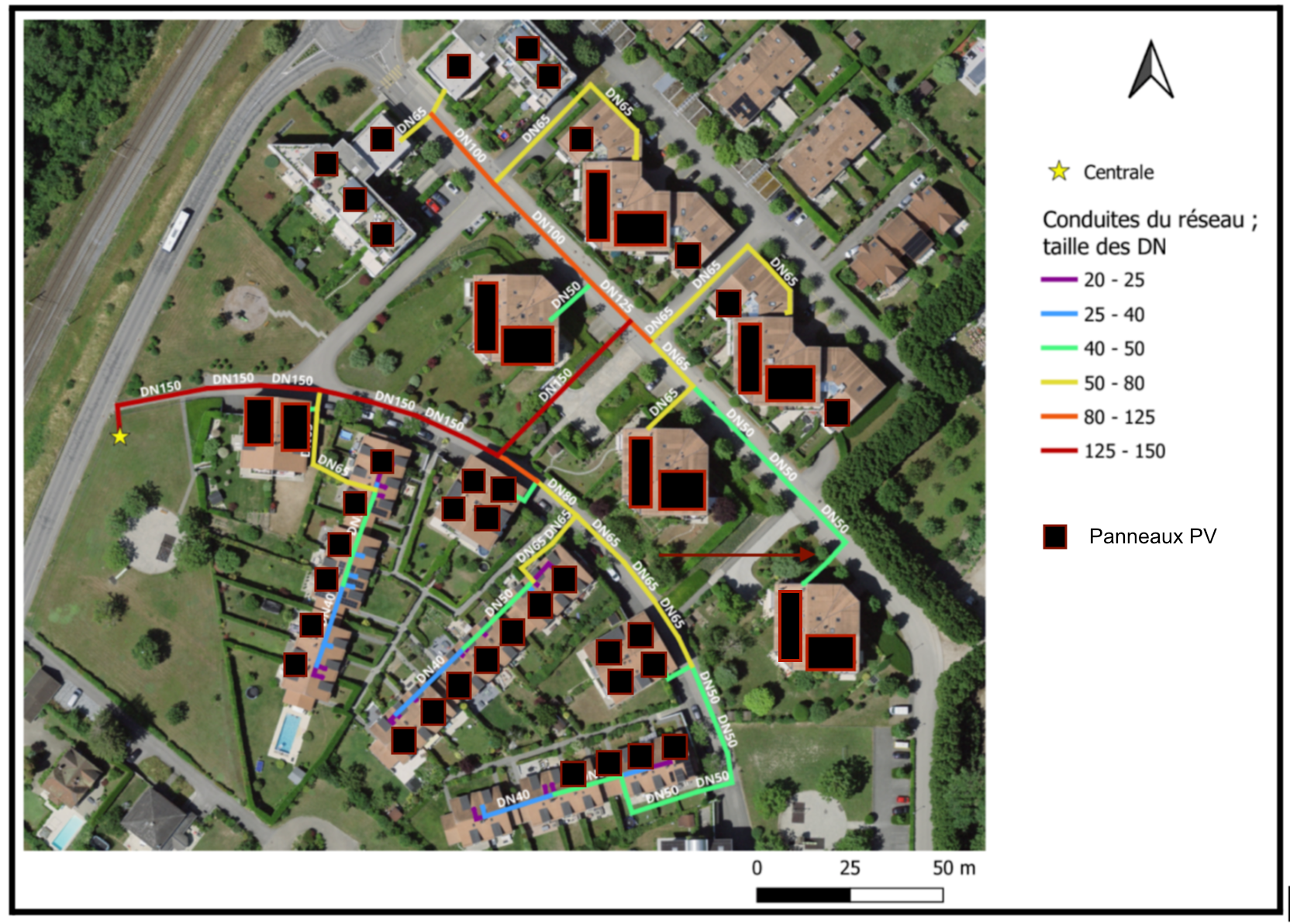
The goal is full energy autonomy, heat and electricity, for 150 homes across 10 PPEs (condos) in Prangins. Electricity structures are clear (CEL, RCP, RCPv); citizen district heating renovations are not. Governance models integrating existing co-ownership, individual-owner-versus-PPE liability, financing, and decision-making is a gap in Switzerland. This research develops options to bridge both energy streams into one coherent, socially acceptable legal and financing structure, scalable to other projects.
Contact person for the project
Association Mélèzes Energie
Geneva Guerin
genevag@gmail.com
Prangins, Vaud
Detailed description
What deeper problem are you addressing?
The new energy laws compel fossil fuel use reduction driven both by climate change mitigation objectives and geopolitical concerns related to energy resource security. According to the Federal Statistical Office (FSO), 75-80% of energy consumption for residential sector buildings in Switzerland comes from heating and hot water use, and most heating is fossil fuel feed using oil and gas. Additionally, upward of 60% of all dwellings are in the form of PPE condominiums (propriété par étages / stockwerkeigentum) a form of collective ownership in which individual owners hold exclusive rights to their private unit while jointly owning and managing the building’s common elements (e.g., structure, roof, corridors, and technical infrastructure).
Today, heating systems are led by market-driven utilities and treated as third-party decisions, even though they are part of large, shared urban infrastructure. This creates a systemic lock-in where collective citizen-led community solutions (like district heating) are challenging to pursue due to fragmented ownership, unclear responsibility, and unclear financing options for collectives in order to comply with the energy laws. Mixed-ownership neighbourhoods (condominiums, elderly owners, low-income residents) face structural barriers to collective investment due to insufficient financing tools and unclear liability structures. Citizens are end-users, not co-designers or co-owners of these systems.
Problem: Governance models for citizen-led district heating renovation projects involving existing PPEs do not exist in Switzerland.
Legal frames for electricity exist in the form of local electricity communities such as CEL (LEG in german), RCP (ZEV in German) and RCPv (vZEV in German), which remain institutionally and functionally distinct from thermal/heat energy governance, particularly for renovation projects.
Which habits or practices do you want to change — and how?
The Swiss energy legislation primarily assigns responsibility to property owners, rather than to intermediary public or private actors, for the development and implementation of compliance solutions. In the Swiss context, particularly in Romandy, institutional and cultural preferences tend to favour authority-driven approaches, with established trust placed in actors such as cantonal energy agencies and municipalities. While citizen-led initiatives are legally feasible, their uptake remains constrained by limited familiarity with alternative governance arrangements and a generally cautious disposition toward institutional experimentation.
We hope to address such barriers to social acceptance by providing detailed options to frame ownership, liability, decision-making and financing. These options will be informed by local and international best practices, with the objective of facilitating the operationalization of citizen-led energy governance models.
Who will benefit — and how could your idea create impact beyond this project?
The direct benefactors are the households of this project. The 150 dwellings currently produce 306 tonnes of annual CO₂e from heating alone, which can be reduced to zero.
The indirect benefactors are other citizen-led renovation projects comprising PPEs (Condominium) in Switzerland that can draw from the models developed. Given the large percentage of building stock organised in PPEs (Condominium), the scaling potential is high, particularly among those without third party provider options.
Has the idea already been tested — and if so, what did you learn?
In the Mélèzes neighbourhood of Prangins, citizen-led public consultations began in 2023 after the ten PPEs each conducted CECB+ evaluations. The studies showed that individual solutions for each building are challenging, due primarily to lack of space for heating installations, however, connecting the buildings with district heating and a centralised thermal power station is optimal. The first consultation laid the framework to pursue a collective option and each PPE subsequently voted to contribute to a sociofinancing campaign to fund a feasibility study (30,000CHF). The Association Mélèzes Energie was created to manage the initiative and the study was conducted in 2023/2024, resulting in three technical options using shallow geothermal ground-water heat pumps ranging in price from 6 to 10 million CHF. Three more public consultations to present and discuss the results occurred between 2024 and 2026. They evolved from technical feasibility to social feasibility and the next step is to present a concrete project proposal on which all PPEs can vote.
All consultations were well attended (30-60 people) and social buy-in has been established by those present.
Something important learned during the consultations is that many expect the Commune or another third party to propose a larger project. While several discussions are on-going on this front, no concrete options have yet been proposed, despite some being explored and subsequently abandoned. The law targets property owners, not third parties, so continuing to explore the citizen-led option in the absence of an alternative is desirable.
The real test will be how the PPEs vote, so the content of the proposal needs to be as detailed as possible to continue building confidence. Specifically, it needs to provide governance model/s and financing options to establish a legal structure, before being able to advance to design development (SIA 112), which costs roughly 5-7% of the total project budget, requiring more subst
What do you want to work on during the booster — and what do you want to find out?
We want to build a prototype of socio-legal models (ownership, financing, liability, governance) that turn district heating/cooling and common solar PVs into a viable collective solution by enabling residents to co-own, co-govern, co-finance and designate responsibility for energy infrastructure as a collective solution.
Specifically we want:
- to study local and international best practice for both governance and financing options by identifying enabling institutional conditions, regulatory constraints and legal entry points; and
- to develop a model with clear co-ownership, liability, decision-making and financing structures that integrates or otherwise bridges the electricity and heating legal frameworks into one structure.
What is your most important learning goal — and how would you know if you need to change course?
We want to understand if one governance model is appropriate for:
- existing PPEs in renovation projects, with a clear structure for liability and governance (I.e., Is the PPE as one co-owned structure liable or are individual owners liable? Does the PPE vote as one unit or do its individual members vote? Can opt outs be integrated? Is the best legal structure a cooperative, an SARL, or other?); and
- for combining both electricity and heating systems in one structure.
During research we will know we need to change course if:
- an appropriate legal structure that bridges electricity and heating in a renovation project is not feasible. At this point, separate or phased structures would be considered; and
- the optimum governance model includes individual owners over PPEs, in which case a more complex co-ownership model will be explored.
Subsequently, the ultimate test is whether the PPEs vote positively to adhere to the project.
Who are your concrete test partners?
Association Mélèzes Énergie (AME): the citizen neighbourhood group leading the project, which will test the possible governance solutions for project implementation.
UNIL: the university partner providing academic oversight and research capacity.
AME has been working with Selin Yilmaz of UNIL’s Geopolis since early 2025 to develop the research project. An initial project proposal was created which sought UNIL Interface and Cantonal pilot project funding, however the funding landscape changed dramatically in 2025 due to various budget cuts, and funding from the public sector was not achieved. An oversight committee including the Canton de Vaud (DIREN) and the Commune of Prangins was also established in the process to guide and give feedback into the process, which can still be mobilised.
What do you hope to get from the booster?
Dedicated time to remunerate the deep dive research required to flesh out governance and financing options, which can subsequently be tested.
Who is on your team — and what is each person's or organisation's role?
Association Mélèzes Energie: Geneva Guerin co-founded AME and has been guiding the citizen project since 2022. She will be the principal researcher. She holds a MAS in Architecture and Sustainable Development from EPFL and has worked as a green development and energy transition consultant for over 20 years.
UNIL: Selin Yilmaz is professor in Geopolis with expertise in community energy solutions. She will provide academic oversight, supervision and research capacity in the form of directed studies or masters students.
Who do you need as an expert to further develop your idea?
Expert knowledge in various legal structures (including cooperatives), governance and liability.