Short description
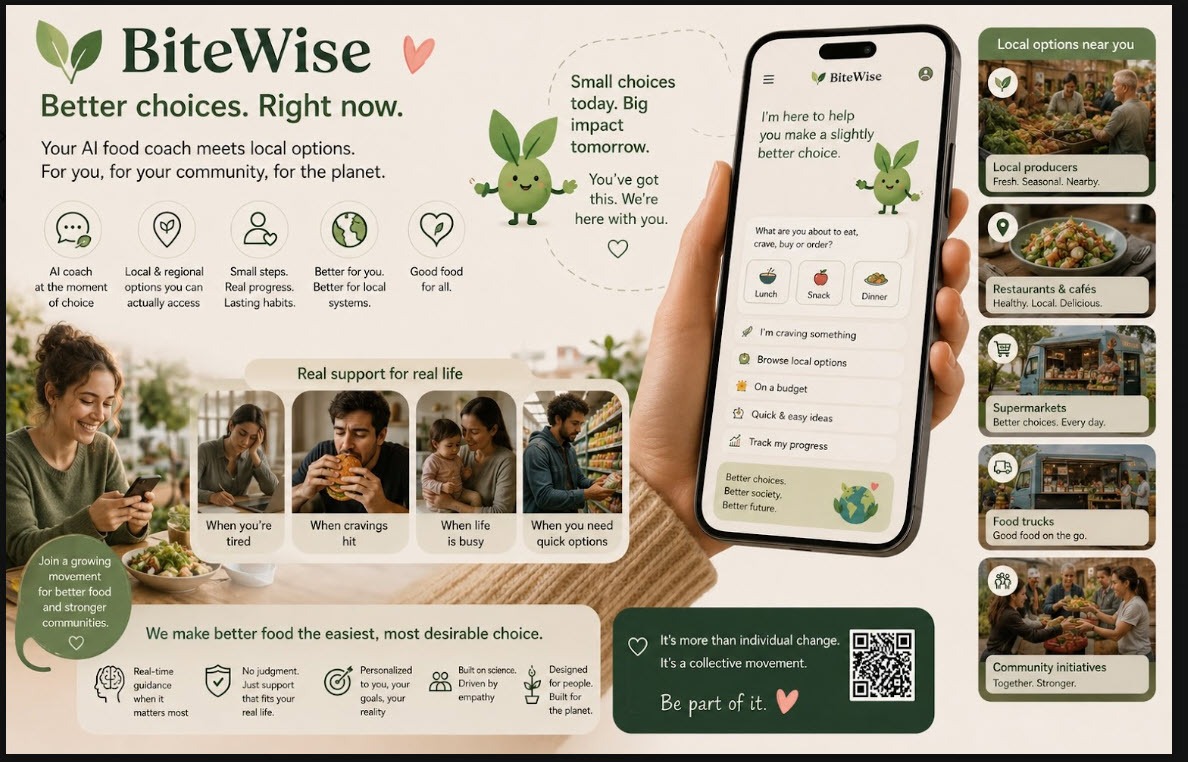
BiteWise is a non-judgmental AI food coach that helps people make slightly better food choices at the moment of decision. It combines real-time behavioural support with a local food options aggregator, guiding users toward healthier, affordable, seasonal and regional options they can actually access in daily life.
Contact person for the project
No
Giulia Jagan
giuliajagan@gmail.com
St. Gallen
Detailed description
What deeper problem are you addressing?
Most adults in Switzerland know what healthy eating looks like. That is not the problem. 61% of Swiss adults say they try to eat healthily, yet ultra-processed foods account for 31% of total calorie intake. The gap between intention and behaviour is large, well-documented, and it does not close with more information.
The gap happens at the moment of decision. When someone is tired, stressed, or pressed for time, their choice defaults to whatever is fastest and most available. Research from the ETH Zürich 10-year Food Panel confirms that automatic habit and emotional state, not knowledge or intent, govern most daily food decisions.
Existing tools often respond with more information: calorie counters, meal plans, and dietary guides. These require a calm, planning mindset and are least useful under stress. When they surface with rules or correction, shame and guilt can become reasons for disengagement.
BiteWise starts from this deeper problem: not a lack of knowledge, but a lack of timely, realistic, emotionally safe support when daily food choices are actually made. It works directly at the decision point, helping users make one slightly better choice within their real constraints of time, budget, appetite, emotional state, and what is available around them.
Which habits or practices do you want to change — and how?
BiteWise works on two levels -
1. First, it aims to change the everyday habit of defaulting to the fastest and most convenient food option when people are tired, stressed, or short on time.
The goal is not to make users follow a strict diet. The goal is to help them pause at the moment of choice and identify one slightly better option that still fits their real situation: their time, budget, appetite, emotional state, and what is actually available around them. This first level is about reshaping demand. BiteWise helps users understand their current food habits, experience the benefit of slightly better choices, and gradually develop a more natural preference for healthy, nourishing food.
2. BiteWise is designed to make better local and regional food options the default recommendation whenever they are available and accessible. Once a healthier preference begins to form, BiteWise connects it to the right supply. When users look for lunch, groceries, or quick meal ideas, the system gives preference to affordable, seasonal, regional, and community-based options before suggesting more generic alternatives.
In this way, BiteWise strengthens both sides of the system: it helps people want healthier food more naturally, while also making local and regional food choices easier to discover, choose, and repeat in everyday life.
The change happens through repetition of small, achievable choices. Each small success builds confidence, and over time this can shift preferences and routines, making healthier and more regional choices feel easier, more normal, and more automatic.
Who will benefit — and how could your idea create impact beyond this project?
The primary users are urban adults who intend to eat well but regularly do not, especially under stress, time pressure, or life transitions. This is a meaningful addressable group: in Switzerland, most adults report trying to eat healthily, while a large share still relies on ultra-processed foods in daily life. BiteWise starts with the segment where the need is most visible: German-speaking urban adults, where ultra-processed food intake is highest and work pressure is well documented (4).
The benefits extend beyond individuals. Regional food already exists in Switzerland, but often does not reach households at the moment food decisions are made. This is not necessarily due to lack of interest: 83% of Zurich consumers say they want to support local farmers. The barrier is that finding suitable local options requires planning, knowledge, and time that many people do not have in everyday life.
BiteWise creates impact by connecting healthier demand with better access. As users develop a stronger preference for nourishing food, the system guides them toward affordable, seasonal, regional, and community-based options nearby. For regional producers, local food outlets, and community initiatives, BiteWise can become a consumer-facing channel that makes their offer easier to discover without requiring them to build new infrastructure from scratch.
Over time, better daily food choices can reduce the risk of diet-related conditions such as obesity, type 2 diabetes, and cardiovascular disease, which represent a significant and growing share of Swiss healthcare costs. Prevention that works at the moment of decision, in everyday life, is what makes this approach relevant beyond the individual.
In the long term, BiteWise could help shift everyday demand toward healthier and more regional food choices, supporting the goal of making good nutrition an accessible daily standard rather than a premium niche.
Has the idea already been tested — and if so, what did you learn?
The idea has not yet been formally tested as a product. So far, the core interaction model has been explored through personal experimentation with AI tools during cravings, meal decisions, and food planning, and compared with findings from literature reviews on behaviour change, self-efficacy, AI coaching, and habit formation. These early explorations suggest that conversational support at the moment of decision may be more actionable than static advice.
Three learnings stood out:
1. Timing matters more than content: support at the moment of decision influenced behaviour in ways earlier or later advice did not.
2. A non-judgmental tone is a condition for engagement: when the interaction felt corrective, moralising, or restrictive, users were more likely to disengage.
3. Guidance only works when it fits real constraints: suggestions that considered time, budget, appetite, emotional state, and availability were more likely to be acted on.
What remains untested is whether this works beyond the founder’s own use case, across different socioeconomic, cultural, and life contexts, and whether it can reliably connect behaviour change to affordable, local, and regional food options. These are the questions the booster phase is designed to test.
What do you want to work on during the booster — and what do you want to find out?
During the booster, we want to build and test a minimal functional prototype of BiteWise with two connected components: a real-time, non-judgmental AI coach that supports users at the moment of a food decision, and a local food options aggregator that makes immediately available healthy, regional, and community-based choices easier to find.
The first component is the conversational coach. It supports users during real food decisions without requiring meal planning, calorie tracking, or retrospective logging. The user shares what they are about to eat, crave, buy, or order, and BiteWise responds with one realistic improvement that fits their situation: time, budget, appetite, emotional state, and what is actually available.
The second component is the local food options layer. It aggregates immediately available choices nearby, including food trucks, supermarkets, restaurants, regional producers, community food initiatives, and online delivery services where relevant. This allows BiteWise to recommend concrete options the user can access in that moment.
Together, these components allow us to test the core assumption: can real-time AI coaching influence what people actually choose, and can the same interaction increase the visibility and uptake of local and regional food options?
We will test with clearly defined user groups: people in life transitions, such as pregnancy, new parenthood, or a new job, and working adults who often make reactive food decisions under stress or time pressure. Testing will take place in real decision contexts, not lab conditions.
The four assumptions to validate are:
1. Users engage with the tool at the moment of decision, not only when planning or reflecting afterwards.
2. A non-judgmental, real-time interaction helps users make different choices than they would have made alone.
3. Small, realistic suggestions, rather than rules, are perceived as actionable and can begin to build new habits over time.
4. Surfacing immediately available he
What is your most important learning goal — and how would you know if you need to change course?
Our most important learning goal is to validate whether BiteWise can create real value at the moment of decision: when users are hungry, stressed, craving something, buying food, or choosing what to order.
We need to find out whether users actually engage with a real-time AI coach in these moments, whether the interaction influences their choices, and whether surfacing immediately available local or regional options makes those choices easier to act on.
We would need to rethink the approach if testing shows that users do not use BiteWise during real decision moments, or if fewer than a meaningful share of testers report that the interaction helped them make a different or slightly better choice. We would also reconsider the aggregator model if users find local options interesting in theory but do not act on them in practice.
In that case, we would analyse whether the issue is the interaction model, the timing, the user segment, the type of recommendation, or the accessibility of the local offers. Depending on the findings, BiteWise might need to shift toward another entry point, such as planning support, workplace food contexts, pregnancy or parenthood-specific use cases, or a more curated local food discovery model.
To avoid confirmation bias, user interviews will include open-ended questions and real-use feedback, so participants can describe what actually helped, what felt irrelevant, and what would need to change.
Who are your concrete test partners?
We are building the test partner network through four access routes:
1. Judy Leong’s health and wellness network: gym owners, nutritionists, and health-oriented communities for early tester recruitment.
2. Our personal and professional networks: behavioural therapists and people working with habit change, stress, and life transitions to refine the testing approach.
3. Swiss knowledge holders: ETH Zürich researchers working on food behaviour and food systems, and public-sector actors connected to national nutrition monitoring, including menuCH, to request interviews and explore collaboration.
4. Food-system actors: regional producers, local food initiatives, supermarkets, restaurants, food trucks, and delivery services to understand what data could realistically be surfaced in the prototype.
We would welcome FUS matchmaking support to identify suitable research, implementation, and food-system partners.
What do you hope to get from the booster?
We hope to get three things from the booster:
1. Access to the right test contexts, so we can test BiteWise beyond health-conscious early adopters and understand whether the approach works in realistic everyday situations.
2. Connections to regional food actors, including producers, distributors, local food initiatives, supermarkets, food trucks, restaurants, and delivery services, to test whether BiteWise can become a practical bridge between user demand and immediately available regional or healthier food options, and to start forming partnerships for the aggregator part of the application.
3. Expert input on behavioural science, nutrition, public health, and food systems, so the testing methodology is credible and the findings are useful beyond the prototype.
In short, the booster should help us move from a promising concept to a grounded test with the right users, real food options, and credible partners.
Who is on your team — and what is each person's or organisation's role?
BiteWise is co-founded by Giulia Jagan and Judy Leong.
Giulia Jagan brings a background in Product Management, Interaction Design, and AI-driven product development. She leads product vision, prototype development, user research design, testing coordination, and project strategy.
Judy Leong brings first-hand experience in healthy living through food, exercise, habit change, and longevity, combined with a professional background in support, training, and customer-facing communication. She is currently upskilling in AI and contributes direct access to gym owners, nutritionists, and health-oriented communities. She leads community engagement, user testing recruitment, and expert network development.
Together, the founding team combines product strategy, AI-enabled prototyping, user-centred design, behavioural insight, community access, and practical experience in healthy lifestyle change. The team is now seeking a research partner and an implementation partner with the legal structure required to receive the grant.
Who do you need as an expert to further develop your idea?
We need expertise in two areas:
Behavioral science and nutrition: to validate the coaching methodology, align the prototype with evidence on habit formation, self-efficacy, and non-judgmental behaviour change, and define a credible testing approach.
Food systems and regional supply: to ground the local discovery layer in how regional food distribution works in Switzerland, including producers, supermarkets, food trucks, restaurants, delivery services, and community-based initiatives.
Where possible, we would also like to consult ETH Zürich researchers working on food behaviour and food systems, as well as public-sector actors connected to national nutrition monitoring, including menuCH.