

What deeper problem are you addressing?
The food system in Oberbaselbiet, like elsewhere in Switzerland, is getting increasingly disconnected. Regional producers and the institutional kitchens that feed schools, hospitals, retirement homes, and workplaces in the same valleys exist a few kilometres apart, but the relationship between them runs almost entirely through procurement systems built for scale and standardisation: specifications, RFQs, wholesale catalogues, price comparisons. These systems handle volumes well but disconnect the actors from each other. They crowd out the social conditions under which regional food cooperation actually works.
The deeper problem we address is therefore not coordination as such, but the steady disconnection of food relationships that should be commons-like, collectively stewarded across producers, kitchens, eaters, and the regional landscape that sustains them. The systemic hypothesis we start from is that food supply chains suffer (in particular those mediated by digital platforms like Feld-zu-Tisch) from a missing layer of social infrastructure: the formats, occasions, and rituals through which collective catering and regional producers can become reliably known to each other and act as co-stewards of a regional food system. Without this layer, well-intentioned regional sourcing defaults to one-off matchings or remains locked in pilot mode. LMN has observed this pattern repeatedly: willingness on both sides, no conversion to stable relationships. The everyday practice we ultimately want to change is what regional kitchens serve and how regional producers route into institutional food, habits that touch many people each day. The structural barrier we tackle is the absence of working commons-like formats that reconnect actors and turn interest into commitment.
Which habits or practices do you want to change — and how?
Two interlocking everyday practices, both deeply habitual, neither currently organised as commons. The first is how collective catering operations encounter producers/: procurement officers, head chefs, and kitchen managers today encounter producers through specifications and price lists. We want them to encounter producers as fellow stewards of a regional food system, in a facilitated format where they articulate what they need ("we could absorb 200 kg of carrots a week from October if you can deliver pre-washed by Tuesday") and what they can give in return - planning visibility, payment terms, kitchen waste streams, communication discipline. The second is how regional producers offer themselves to institutional buyers: producers today respond to RFQs or send catalogues. We want them to articulate concrete offers and concrete needs in a format that lets a kitchen meet them as a co-steward rather than a vendor.
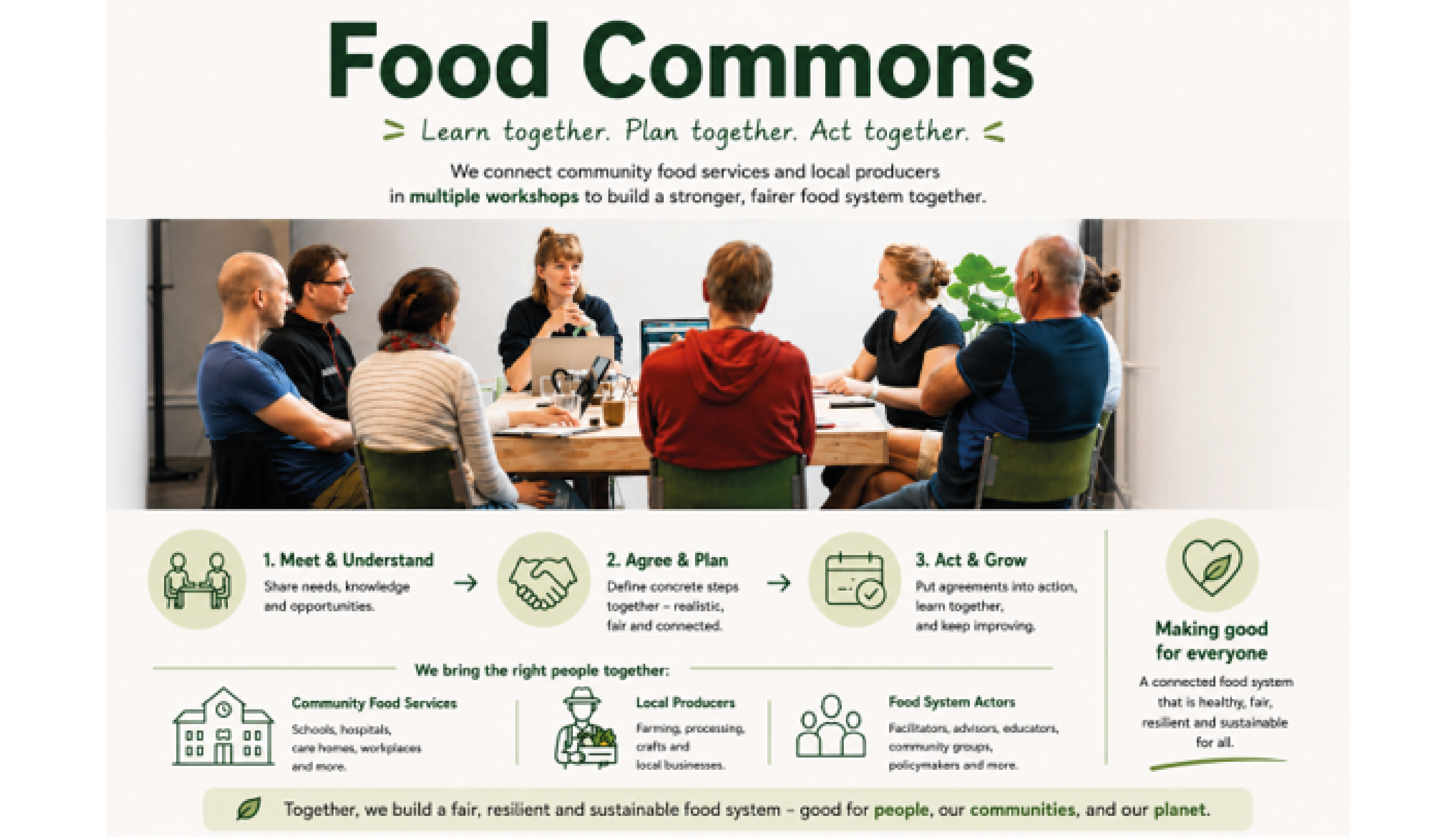
The mechanism is the Commons-Werkstatt - a facilitated, recurring format where collective catering operations, producers, and food-system intermediaries (like LMN) do the practical work of building and maintaining the regional food commons together. The format draws on three traditions of reciprocity-based food practice. “Solidarische Landwirtschaft” (Solawi/CSA) has demonstrated for decades that committed, reciprocal contracts between producers and eaters can sustain alternative food relationships outside dominant retail logics. “Ernährungsräte,” food policy councils in German-speaking Europe, have built collective food-governance bodies that convene producers, kitchens, public institutions, and civil society around shared regional food agendas. And the Social Muscle Club (Basel, since 2015) has shown that a structured give/receive setting produces real exchange between strangers and shifts what participants believe is possible to ask of one another. The Commons-Werkstatt takes the reciprocity logic from ‘Solawi’, the governance ambition from ‘Ernährungsräte'.
What do you want to work on during the booster — and what do you want to find out?
The idea addresses the following challenge: “Wie könnten wir regionale Produzenten unterstützen regionale Ernährungssysteme in die Breite zu tragen, in dem sie neue oder geteilte (Vertriebs-)Infrastrukturen aufbauen und neue Partnerschaften eingehen?”
The booster has three concrete, interdependent strands.
Design: FHNW leads format design and moderation development, drawing on Solawi, Ernährungsräte/Ernährungsforen, and SMC traditions, with LMN providing ecosystem knowledge and evaluation built into the format from the start.
Pilot: we host at least one full Commons-Werkstatt in Oberbaselbiet, targeting 3–5 regional producers and 2–3 regional/institutional kitchens. Documented offers, requests, and agreements come out of the workshop.
Research: FHNW conducts research on format design and observes/documents the workshop. The most important assumptions to test, in order of dependency: that regional producers and regional/institutional kitchens are willing to participate in a face-to-face exchange format and not just respond to surveys; that preparation interviews help surface concrete needs, constraints, and realistic supply opportunities; that producers and kitchens articulate concrete offers and needs in the format rather than generic interest; that concrete agreements or next steps arise at the workshop itself; and that these agreements can be moved into early implementation through structured follow-up.