

What deeper problem are you addressing?
Modern food systems systematically disconnect people from local production, ecological cycles, and collective stewardship of food infrastructure. This disconnect is particularly visible in cities, where access to healthy and sustainable food often depends on income, education, convenience, and social capital.
At the same time, many products marketed as “healthy” or “natural” — including herbal teas — are embedded in globalized supply chains with high transport emissions, opaque production conditions, and industrial processing that reduces freshness, biodiversity, and local economic resilience.
Research increasingly shows that sustainable diets cannot be achieved through individual consumer choices alone. According to the latest findings from food systems research and the IPCC, meaningful transformation requires changes in social infrastructure, local provisioning systems, participation mechanisms, and collective access models. Urban agriculture and community-supported food systems can strengthen climate resilience, biodiversity, social cohesion, and food literacy simultaneously.
However, many solidarity agriculture (CSA) or alternative food initiatives remain relatively niche and socially homogeneous. Access barriers often include high upfront costs, cultural codes, time constraints, lack of proximity, and insufficient integration into everyday urban life.
Our hypothesis is that small-scale, hyperlocal, neighborhood-based food commons can lower these barriers if they combine convenience, community participation, affordable access, emotional connection, and visible local impact.
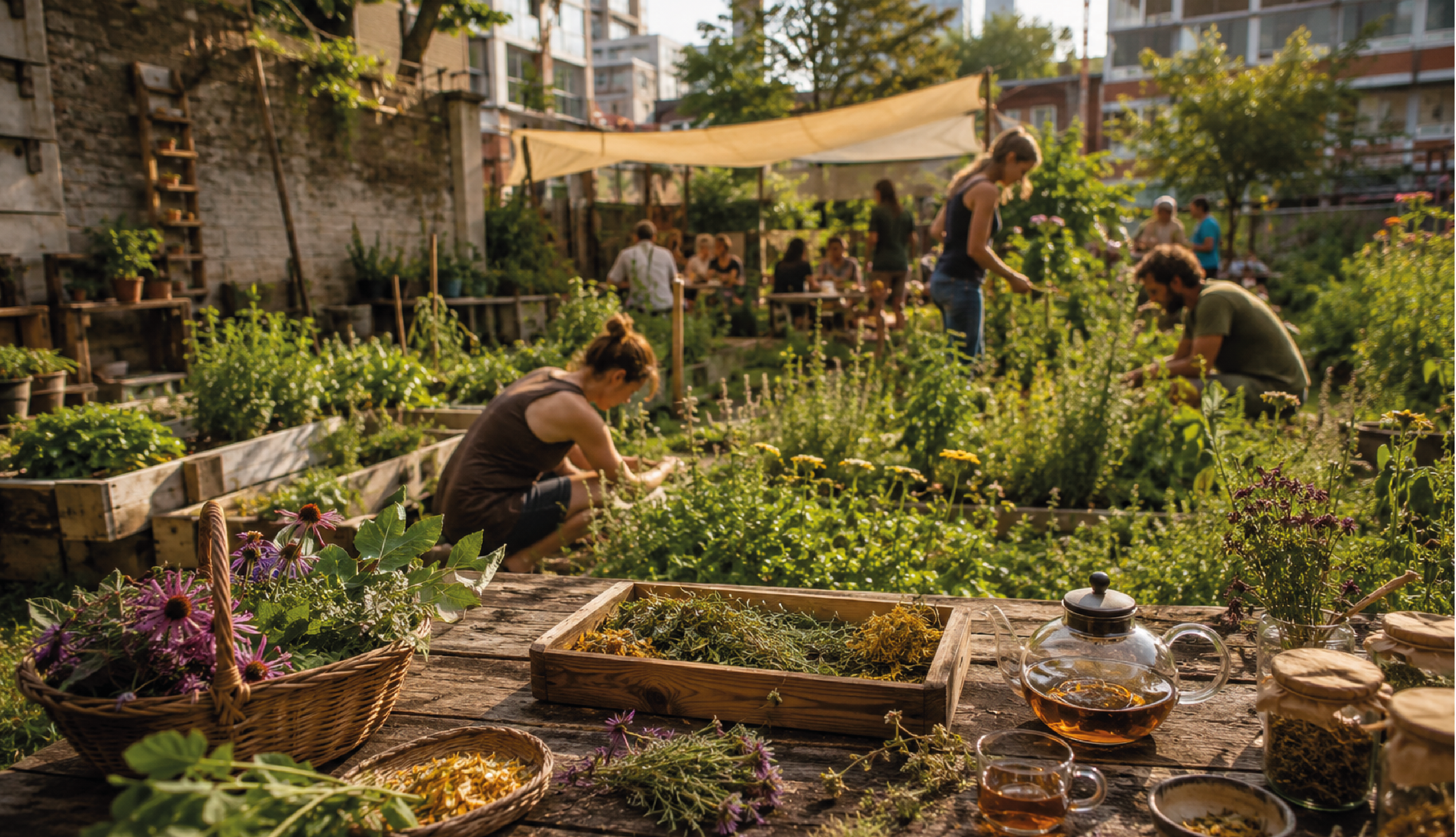
millefoli addresses this gap through an urban herbal CSA model that transforms an underused urban plot into a participatory food and biodiversity commons. Herbs and tea are particularly suitable because they require relatively little space, have low ecological footprints, can be harvested repeatedly, and create immediate emotional and sensory connection through smell, taste, and everyday use.
Which habits or practices do you want to change — and how?
millefoli targets three interconnected habit clusters:
1) Passive consumption of imported, packaged goods
We want to shift the default from "buy a tea bag at the supermarket" toward "receive a seasonal blend grown 15 minutes from home, by people I know." The solidarity subscription model makes this not only possible but convenient: members receive their monthly package without having to seek it out. Research on community-supported agriculture (CSA) shows that subscription structures are one of the most effective mechanisms for sustained behaviour change in food consumption.
2) Disconnection from plant knowledge and seasonal cycles
Industrial food systems have systematically eroded practical knowledge of local plants, their uses, and their growing seasons. millefoli rebuilds this knowledge through hands-on participation: members are invited to sow, tend, harvest, and process — learning the identity, scent, and effect of each plant. This is not incidental; it is structural. The more members know about what they grow, the more they value it, and the more resilient the community becomes as a food-literate neighbourhood node.
3) Underuse of urban land as food space
The project occupies an interim use site (Freihaltefläche) granted by the City of Zürich, land that would otherwise remain unused. By activating this space as a productive, social, and ecological asset, millefoli demonstrates that urban land policy can be a direct lever for food system transformation. We are building the habit both in institutions and in residents of seeing urban open space as a candidate for community food production.
What do you want to work on during the booster — and what do you want to find out?
During the booster we want to:
Launch and test the solidarity subscription model with a founding cohort of 20-30 members, observing how members self-select their contribution level and whether the model generates sufficient, stable income to cover operating costs.
Test community engagement mechanics — specifically: which formats (harvest workshops, open days) most effectively attract and retain participants from the full demographic range of the neighbourhood, including people not already embedded in sustainability networks.
Develop a replication toolkit — documenting what we learn about land activation, subscription design, and community building in a format usable by other groups in other cities.
Key assumptions we want to test:
Assumption 1: A solidarity pricing model (members choose their contribution within a defined range) is stable — i.e., enough members choose higher contributions to cross-subsidise lower ones, generating a viable average. People will financially support a solidarity-based food commons model.
Assumption 2: Participation in growing activities is not limited to already food-conscious or high-education demographics, but can be broadened through the right programming and outreach via neighbourhood institutions. We can lower participation barriers through smaller-scale and more flexible involvement.
Assumption 3: 330m² of growing space can reliably supply 40–60 members with monthly products while sustaining ecological quality and volunteer engagement. Local tea production can become a recognizable neighborhood identity project.