

What deeper problem are you addressing?
Since beginning of 2026 the regulatory framework in Switzerland allows the creation of local energy communities (LECs), which has stimulated some initiatives and new business models or tools. However, they all lack social structures, examples and mechanisms for local initiatives. Clarity, transparency, and citizen ownership in LECs from the beginning leads to higher acceptance, broader participation and stronger local value creation – even beyond economic value alone (Heinz, 2023).
The dominant practice today is that municipalities, after evaluating regulatory, technical, and economic feasibility, commonly plan to establish LECs first for their own buildings (e.g. Feasibility Study LEG Escholzmatt-Marbach.pdf). Then, once economic viability is proven, the municipalities plan opening participation to its citizens, acting cautiously instead of proactively enabling participation from the beginning. Similarly, local electricity providers provide local LEC platforms to initiate and manage them e.g. ewz, Stadtwerk Winterthur. LEGhub.ch, a collaborative provider-driven platform, supports consumers in both finding and initiating a LEC in Switzerland overall. While these approaches are positive for the overall energy transition, they contradict the core idea of putting citizens at the heart of the energy system through energy citizenship, inclusivity, and bottom-up approaches.
Nonetheless, it is true that creating LECs is challenging, due to data complexity, the tariff-design, network constraints, and the strong dependence of and the immense difference between local network operators (Sauter Yannik, PV-Tagung 2026, “Wer sind die Gewinner der LEG? Erfahrungsbericht aus der Evaluierung und Planung von LEG”). Therefore, citizen-driven LECs will need support without losing their agency.At the same time, an issue is the lack of sufficient installed PV-capacity in the municipality. However, if there is a collective or aggregated demand, it becomes more relevant.
Which habits or practices do you want to change — and how?
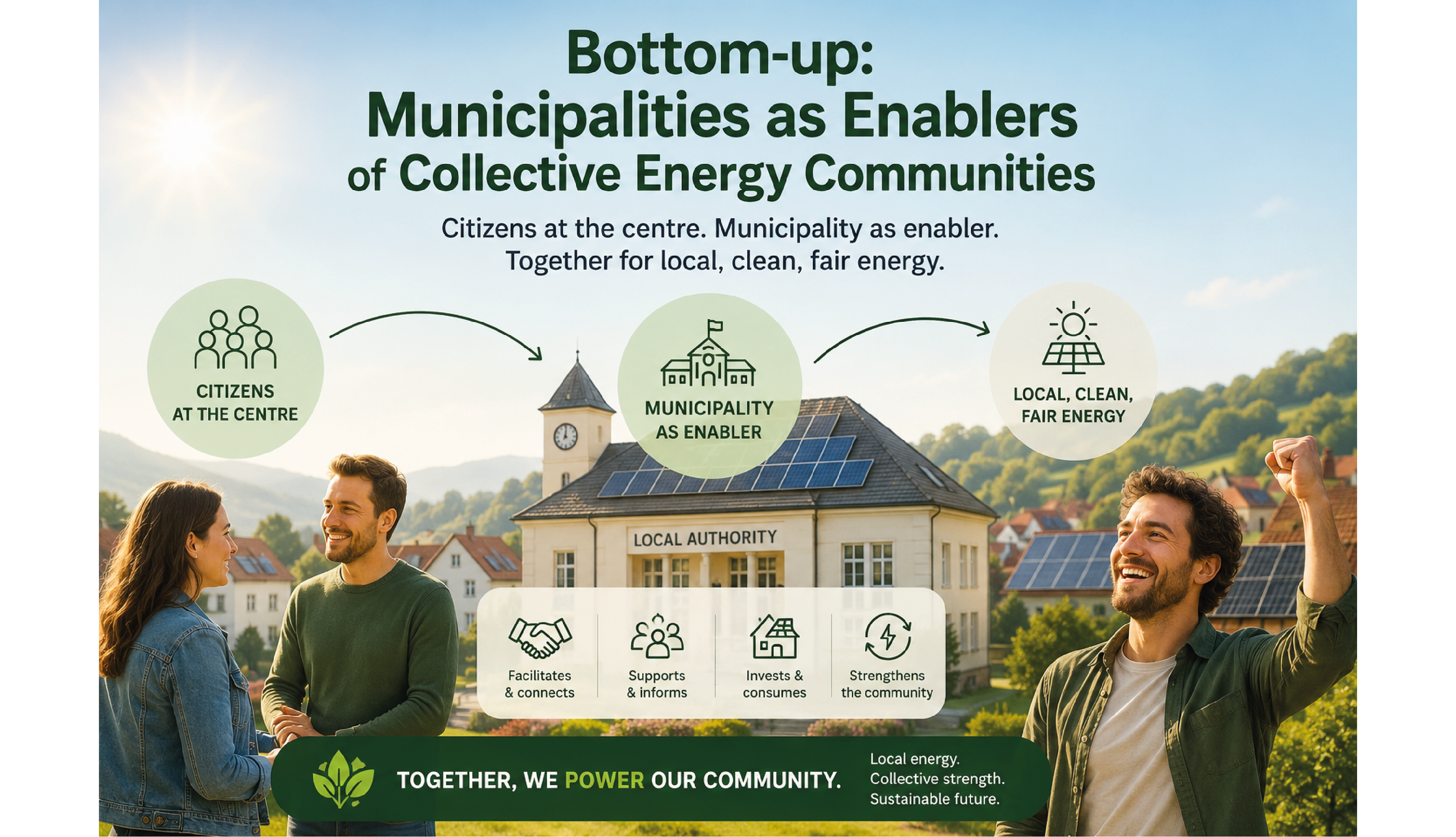
The project aims to change how municipalities initiate energy communities and how energy is socially shared and governed in everyday practice. Today, municipalities typically develop energy communities around their own assets and involve citizens only later, if at all. This project promotes a shift towards municipalities acting as facilitators from the outset, enabling citizens to actively co-create and shape the system. In parallel, it seeks to change the habit of passive and individual energy consumption towards a more collective approach, where citizens see themselves as co-producers, co-shapers, co-investors of a local energy system.
This shift is enabled through a governance and engagement approach that positions the municipality as a facilitator and prosumer, but also anchor consumer, creating a mutually beneficial exchange between citizens and public services. Through participatory processes, clear roles, and transparent mechanisms for sharing energy, the project fosters trust, lowers barriers to entry, and supports more inclusive and cooperative forms of energy use.
It's a mindset change that supports municipalities and citizens to understand that instead of prioritising their individual financial benefits they can have more financial benefits collectively - it also means changing from being risk averse to taking the risk of trusting and involving citizens from the beginning, which has been proven successful in other contexts and countries for the development of energy communities.
What do you want to work on during the booster — and what do you want to find out?
During the booster, we will address the central question of how a municipality can act as an enabler for citizen-driven governance. The goal is to develop a feasibility study for a citizen-driven LEC, including a governance model, clear roles, processes, and a tariff structure, that provides a solid basis for implementation in Buckten and can be replicated in other municipalities. This feasibility study goes beyond regulatory, technical and economc feasibility by emphasising social feasibility.
The work will include analysing legal, organisational and local framework conditions (LEC from 2026), conducting workshops with municipal representatives and interested citizens (with PV, planning to install PV, renters, low-income households), implementing a population survey or run in-depth interviews with selected citizens (of different backgrounds and possibilities) to assess desirability, needs, acceptance and willingness to participate (incl. active participation in decision-making, active consumption or demand response), and engaging key stakeholders such as grid operators (e.g. IWB, EBL). Based on these insights, we will develop a conceptual governance model for a citizen-centred LEC, where citizens take an active role as energy producers and traders, while the municipality acts as a facilitator and anchor consumer.
The key assumptions we aim to test are that (1) citizens are willing to actively participate if given a clear and fair framework, and (2) municipalities can successfully shift from a passive or asset-driven role to a facilitative role that enables energy citizenship. The objective is to demonstrate a viable and desirable model with clear potential and implementation logic, including tariffs and governance, that can be scaled beyond the pilot context.