

What deeper problem are you addressing?
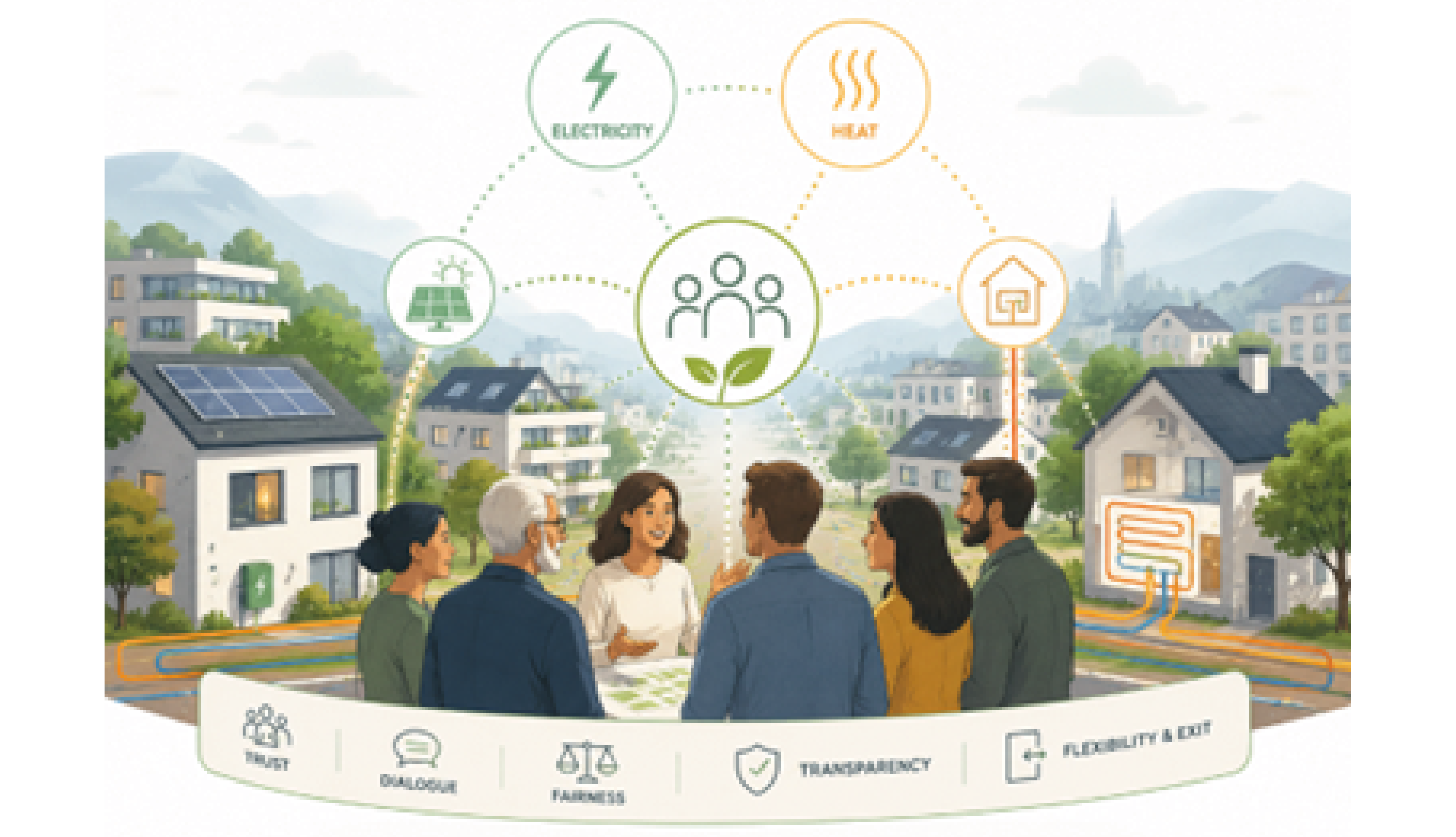
In Switzerland, the current concept of Local Electricity Communities (LECs) focuses primarily on electricity. In contrast, energy communities aim to adopt a more holistic approach by integrating different energy forms and support a just transition . In this context, there is considerable potential in coupling and jointly using both electricity and heat in neighbourhood-scale solutions and through localised district heating systems, known as “nano-networks”.
However, sharing heat within such nano-networks requires infrastructural modifications. These pose not only technical and financial challenges for residents, but above all social ones. The physical interconnection of heating systems increases the need for coordination and often leads to greater scepticism within neighbourhoods. Typical concerns include what happens if a participant sells their property or no longer wishes to be part of the shared system.
Compared with electricity-only solutions, where sharing is virtual and already regulated, issues such as fairness, cost allocation, dependencies, withdrawal, as well as comfort and control become more prominent. As a result, combined electricity-and-heat energy communities present not only technical but, more importantly, social challenges, which begin with communication between the neighbours and sharing benefits.
At the same time, integrating heat into energy communities offers significant synergies compared with standalone solutions. These include increased self-consumption of shared electricity, use of local electricity for local heat pumps, reduced space requirements, and lower overall investment costs . In fact, IWB experiences show, that after the physical interventions to create a nano-network, communities are more willing to adopt a virtual electricity sharing model, too. In conclusion, both the social challenges and the silo-thinking prevent holistic energy communities from becoming mainstream, even though everyday energy use is inherently cross‑sector
Which habits or practices do you want to change — and how?
This project aims to change how people think and act across sectoral silos and how they deal with scepticism towards shared energy systems. Instead of treating electricity and heat as separate domains, energy is reframed as an interconnected system based on trust, transparency and collective design, encouraging neighbours to engage earlier and more collaboratively rather than reacting once technical solutions are fixed. This shifts everyday practices from passive consumption and fragmented decisions towards active participation in shaping local energy systems.The approach builds on close collaboration between two private-sector partners to develop a practice-oriented, user-centred process that bridges silos and addresses social challenges. By engaging with existing nano-network pilots and potential participants across Switzerland—combining Rapp’s and IWB’s insights and client bases—we explore real needs, expectations and concerns, and co-create a Social Design Toolkit addressing scepticism around fairness, control and complexity. As a social innovation, the project connects utilities, planners, municipalities and citizens to clarify roles, build partnerships and reduce uncertainties. The ultimate goal would be, to be able to change behaviour and not only attitudes.
What do you want to work on during the booster — and what do you want to find out?
During the booster, we will develop and test a practice-oriented service and operating model for integrated electricity–heat energy communities, based on real user needs and stakeholder dynamics.
First, we focus on desirability: whether early, structured social engagement increases acceptance, trust and willingness to participate. We combine qualitative interviews with nano-network and ZEV participants or more intervention oriented approaches such as workshops or role play (depending on expert support), a comparative analysis of neighbourhood typologies using IWB data, and a large-scale survey (target: 500+ respondents) distributed through IWB and Rapp networks. The University of Basel provides methodological feedback, especially for survey design.
The insights will be synthesised into three key deliverables:
- A Social Design Toolkit with practical methods to address concerns early, including co-design formats, governance models, and communication approaches addressing fairness, control and exit & withdrawal options, and dispute resolution.
- A Process Model for Initiation outlining a clear, step-by-step pathway from exploration to collective decision-making, aligning technical planning with social engagement.
- A Role and Partnership Model defining rules and responsibilities, interfaces and governance for transparent and fair collaboration - addressing concerns regarding ownership changes, withdrawal or shared investments.
Together, these form the “Energy Community Starter Service”—a transferable offering that supports neighbourhoods in initiating integrated energy communities by clarifying roles, implementation, value creation and scaling potential. In doing so, our tools will help translate complex social dynamics into actionable practices that can be applied by citizens, municipalities, utilities and planners.