Short description
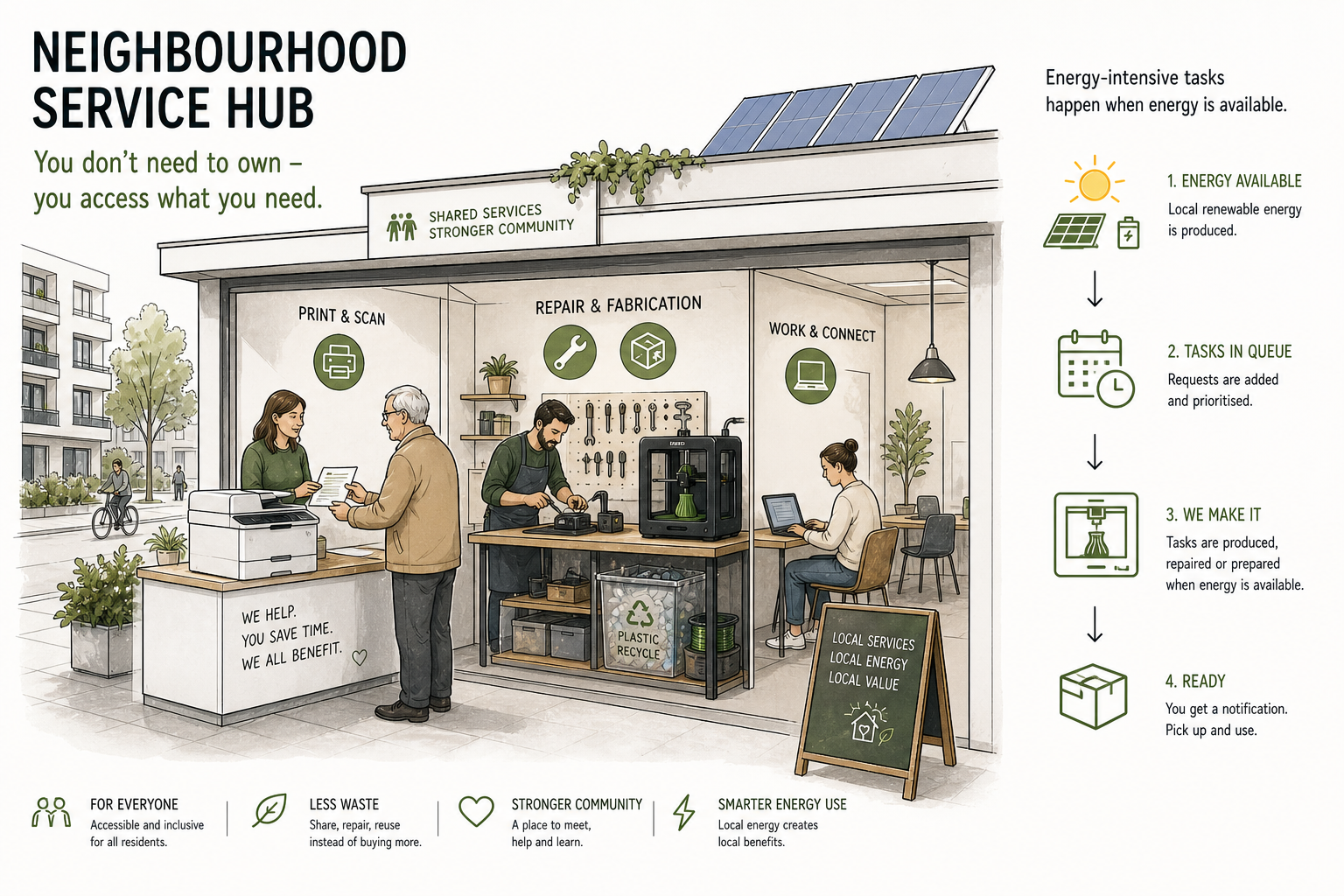
A Nano Fab Lab providing shared services such as printing, assistance and small-scale repair, reducing the need for individual ownership of devices. Energy-intensive tasks are scheduled during periods of local renewable energy availability, linking everyday services with energy use. The project explores how shared infrastructure can improve access, reduce consumption and create local value for residents.
Contact person for the project
S2S Sàrl
Alexander Sokolov
alexander.sokolov@hevs.ch
Onex
Detailed description
What deeper problem are you addressing?
Local renewable energy production is increasing, but it remains largely disconnected from everyday life. Energy is produced locally yet often remains invisible to residents, especially tenants, who rarely experience direct benefits beyond electricity consumption.
At the same time, many everyday services and resources remain fragmented and individually owned. Printers, tools, small repair equipment and fabrication capacity are duplicated across households, used infrequently and often replaced rather than repaired.
The project addresses the structural gap between local energy availability, access to services and everyday practices. It explores whether local energy communities can create visible local value through shared services and neighbourhood infrastructure, rather than functioning only as mechanisms for electricity exchange.
Which habits or practices do you want to change — and how?
We aim to shift from owning low-use equipment individually to accessing shared neighbourhood services when needed. The project explores whether convenience can be maintained while reducing duplicated equipment, unused devices and unnecessary consumption.
We also introduce the idea that some non-urgent services can be organised more flexibly. Rather than expecting everything immediately, residents may choose to use services when local renewable energy is available or when demand on the system is lower.
This is supported through a visible neighbourhood service hub, a simple request and queue system, and a clear distinction between immediate and scheduled services.
Who will benefit — and how could your idea create impact beyond this project?
Direct beneficiaries include tenants, households, elderly residents and building operators. Residents gain access to services and equipment without needing to own them individually. Elderly residents can receive assistance with documents, printing and simple administrative tasks. Households can reduce costs and storage needs.
The project also explores a new neighbourhood service role by extending traditional concierge functions through local fabrication, repair and service coordination.
Beyond the project, the concept could provide a replicable model for residential buildings, social housing projects and neighbourhood-scale energy communities. It contributes to new ways of linking energy, services and local value creation.
Has the idea already been tested — and if so, what did you learn?
The concept builds on existing practices such as shared printers, concierge services, repair cafés, maker spaces and neighbourhood support initiatives. It is also inspired by projects such as the Library of Things developed by Archipel and sharing initiatives such as Manivelle in Geneva, which demonstrate demand for access over ownership and the value of shared local resources.
These examples highlight the importance of a trusted local operator, community-scale services and practical everyday use cases rather than complex technology.
However, we are not aware of examples that combine neighbourhood services, local fabrication and energy-aware operation within the context of local energy communities. This remains the main area to be explored and tested.
What do you want to work on during the booster — and what do you want to find out?
During the booster, we aim to develop a functional prototype of the Local Service Hub and test it within an existing residential or local energy community context. The prototype would include a small service station combining document printing, simple fabrication tools, repair services and a basic digital request system.
We plan to run a short pilot phase (approximately two weeks) with residents and users in order to observe demand, usage patterns and operational requirements. The objective is not to test seasonal solar production, but to understand whether residents use the services, how they interact with the system and whether the concept creates value at neighbourhood scale.
We also want to explore how certain non-urgent services could be organised more flexibly around local energy availability and whether users are willing to accept this approach.
Our main assumptions are that residents are willing to use shared services instead of owning everything themselves, that demand is sufficient to support the hub, and that a single operator can efficiently coordinate the system.
What is your most important learning goal — and how would you know if you need to change course?
Our main learning goal is to understand whether residents are willing to replace individual ownership with shared access to neighbourhood services with limitations linked with renewable energy production
If fewer than 30–40% of targeted residents use the hub regularly, we would need to reconsider the core assumption that shared access can realistically replace individual ownership for a meaningful number of services.
A second learning objective concerns energy-aware operation. If most users require immediate service and are unwilling to accept any scheduling flexibility, we would need to simplify or reduce this aspect of the concept.
Who are your concrete test partners?
We do not yet have confirmed pilot partners. Through the booster, we hope to connect with residential buildings, housing actors, municipalities, local energy communities and resident groups willing to test the concept and provide feedback.
We are also interested in connecting with concierge and facility management actors, digital service providers and local fabrication partners.
What do you hope to get from the booster?
We hope to gain access to pilot partners, testing environments and practical feedback from potential users.
We are looking for support in validating the concept, understanding operational requirements and identifying realistic pathways toward implementation. We would also benefit from connections to municipalities, local energy community initiatives, fabrication partners and digital service experts.
Most importantly, we want to understand whether neighbourhood-scale shared infrastructure can become a practical way for local energy communities to create visible value in everyday life.
Who is on your team — and what is each person's or organisation's role?
Alexander Sokolov S2S Sàrl, Project Lead. Architect with experience in educational initiatives, participatory workshops and community-oriented projects. Responsible for concept development, service design, spatial integration of the hub, user engagement and coordination of pilot activities.
HES-SO Valais-Wallis – Research Partner
Responsible for stakeholder analysis, user interviews, hypothesis testing and evaluation of the pilot.
FabLab Sion – Implementation Partner
Provides fabrication expertise, prototyping support and access to fabrication equipment.
L’Archipel – Implementation Partner
Supports pilot testing with users and contributes experience related to shared resources and neighbourhood-scale services.
Energy Living Lab Association – Communication & Dissemination Partner
Responsible for communication, dissemination activities and co-creation workshops with users.
Who do you need as an expert to further develop your idea?
We have expertise in Local Energy Community development through COPÉR where we have access to several neighbourhoods that are developing RCPv and CELs. However, we are looking for expertise concierge and facility management models, and small-scale fabrication. Archipel provides expertise in shared service systems and digital service platforms however we would like to explore this further. We are also interested in expertise related to neighbourhood circular economy and local material reuse like Resourccerie or Materiuum.