Short description
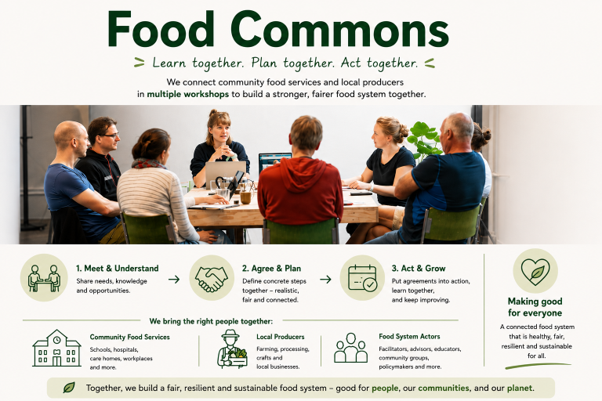
Food Commons Oberbaselbiet reinvents how collective catering and regional producers meet - as a socially designed practice, not a procurement transaction. In the Commons-Werkstatt format, kitchens, producers, and food-system actors articulate concrete needs and contributions face-to-face. Hosted by Genossenschaft Lebensmittel Netzwerk Basel (LMN), moderated by FHNW research, the booster pilots this in Oberbaselbiet as transferable social infrastructure for resilient regional food systems.
Contact person for the project
Genossenschaft Lebensmittel Netzwerk Basel (LMN)
Schön, Christoph
christoph.schoen@markthallebasel.ch
Horburgstr. 103, 4057 Basel
Detailed description
What deeper problem are you addressing?
The food system in Oberbaselbiet, like elsewhere in Switzerland, is getting increasingly disconnected. Regional producers and the institutional kitchens that feed schools, hospitals, retirement homes, and workplaces in the same valleys exist a few kilometres apart, but the relationship between them runs almost entirely through procurement systems built for scale and standardisation: specifications, RFQs, wholesale catalogues, price comparisons. These systems handle volumes well but disconnect the actors from each other. They crowd out the social conditions under which regional food cooperation actually works.
The deeper problem we address is therefore not coordination as such, but the steady disconnection of food relationships that should be commons-like, collectively stewarded across producers, kitchens, eaters, and the regional landscape that sustains them. The systemic hypothesis we start from is that food supply chains suffer (in particular those mediated by digital platforms like Feld-zu-Tisch) from a missing layer of social infrastructure: the formats, occasions, and rituals through which collective catering and regional producers can become reliably known to each other and act as co-stewards of a regional food system. Without this layer, well-intentioned regional sourcing defaults to one-off matchings or remains locked in pilot mode. LMN has observed this pattern repeatedly: willingness on both sides, no conversion to stable relationships. The everyday practice we ultimately want to change is what regional kitchens serve and how regional producers route into institutional food, habits that touch many people each day. The structural barrier we tackle is the absence of working commons-like formats that reconnect actors and turn interest into commitment.
Which habits or practices do you want to change — and how?
Two interlocking everyday practices, both deeply habitual, neither currently organised as commons. The first is how collective catering operations encounter producers/: procurement officers, head chefs, and kitchen managers today encounter producers through specifications and price lists. We want them to encounter producers as fellow stewards of a regional food system, in a facilitated format where they articulate what they need ("we could absorb 200 kg of carrots a week from October if you can deliver pre-washed by Tuesday") and what they can give in return - planning visibility, payment terms, kitchen waste streams, communication discipline. The second is how regional producers offer themselves to institutional buyers: producers today respond to RFQs or send catalogues. We want them to articulate concrete offers and concrete needs in a format that lets a kitchen meet them as a co-steward rather than a vendor.
The mechanism is the Commons-Werkstatt - a facilitated, recurring format where collective catering operations, producers, and food-system intermediaries (like LMN) do the practical work of building and maintaining the regional food commons together. The format draws on three traditions of reciprocity-based food practice. “Solidarische Landwirtschaft” (Solawi/CSA) has demonstrated for decades that committed, reciprocal contracts between producers and eaters can sustain alternative food relationships outside dominant retail logics. “Ernährungsräte,” food policy councils in German-speaking Europe, have built collective food-governance bodies that convene producers, kitchens, public institutions, and civil society around shared regional food agendas. And the Social Muscle Club (Basel, since 2015) has shown that a structured give/receive setting produces real exchange between strangers and shifts what participants believe is possible to ask of one another. The Commons-Werkstatt takes the reciprocity logic from ‘Solawi’, the governance ambition from ‘Ernährungsräte
Who will benefit — and how could your idea create impact beyond this project?
Directly, the cooperative food systems in Oberbaselbiet gain a working format for regional sourcing and stronger ties to producers. Regional producers gain institutional visibility, planning information, and a route into a buyer segment normally locked behind procurement systems. LMN gains a replicable activation format for its cooperative network.
Indirectly but importantly, the pupils, patients, residents, and employees fed by participating kitchens eat differently as a result. This is where the FUS criterion of changing everyday habits shared by many people actually plays out; not by changing consumer behaviour at the supermarket, but by changing the upstream practices of institutions that feed many people every day. A single school canteen with 400 daily meals, shifted toward regional sourcing, changes more eating habits than thousands of individual consumer decisions.
Beyond the pilot, the project produces transferable assets: a documented Commons-Werkstatt format and a facilitation script. These can be adopted by other regional food networks, municipalities, and cooperative food systems. The format is also transferable back into community settings such as markets and neighbourhood food initiatives broadening their societal reach. If the commons frame holds, the project contributes to a broader civic argument that food relationships belong in the realm of collectively stewarded social infrastructure, not only private transaction.
Has the idea already been tested — and if so, what did you learn?
The Commons-Werkstatt format does not exist yet as we propose it, but each of its underlying traditions has a track record we build on. Solawi/CSA approaches in Switzerland and Europe have shown for decades that reciprocal, commitment-based contracts between producers and eaters can sustain alternative food relationships outside dominant retail logics. Ernährungsforen and Ernährungsräte (Food Policy Councils), including the Ernährungsforum Basel (of which LMN is a delegated member organisation), the Ernährungsforum Zürich and the Ernährungsrat Freiburg and elsewhere, have shown that collective food-governance bodies can convene producers, kitchens, public institutions, and civil society around shared regional food agendas. The Social Muscle Club has run as a participatory exchange format since 2015 in Basel and beyond, demonstrating that a structured give/receive setting produces real exchange between strangers. The open question we now test is whether these traditions can be combined and applied to the specific challenge of routing regional production into institutional kitchens in a rural region, and whether a Commons-Werkstatt format produces the stable supply relationships that ad-hoc matching has so far failed to produce.
LMN has facilitated matching between regional producers and gastronomy/institutional actors in the Basel region over recent years. The learning is consistent: interest exists abundantly on both sides but ad-hoc matchings rarely convert into stable supply relationships. The bottleneck is not only finding the right actors, but accompanying the transition from interest to practice. Implementation often breaks down in the operational details: volumes, delivery days, processing requirements, pricing, ordering routines, decision-making authority, seasonal availability, and follow-up responsibility. A key learning from LMN’s previous work is therefore that matchmaking without structured preparation and post-workshop accompaniment tends to remain symb
What do you want to work on during the booster — and what do you want to find out?
The idea addresses the following challenge: “Wie könnten wir regionale Produzenten unterstützen regionale Ernährungssysteme in die Breite zu tragen, in dem sie neue oder geteilte (Vertriebs-)Infrastrukturen aufbauen und neue Partnerschaften eingehen?”
The booster has three concrete, interdependent strands.
Design: FHNW leads format design and moderation development, drawing on Solawi, Ernährungsräte/Ernährungsforen, and SMC traditions, with LMN providing ecosystem knowledge and evaluation built into the format from the start.
Pilot: we host at least one full Commons-Werkstatt in Oberbaselbiet, targeting 3–5 regional producers and 2–3 regional/institutional kitchens. Documented offers, requests, and agreements come out of the workshop.
Research: FHNW conducts research on format design and observes/documents the workshop. The most important assumptions to test, in order of dependency: that regional producers and regional/institutional kitchens are willing to participate in a face-to-face exchange format and not just respond to surveys; that preparation interviews help surface concrete needs, constraints, and realistic supply opportunities; that producers and kitchens articulate concrete offers and needs in the format rather than generic interest; that concrete agreements or next steps arise at the workshop itself; and that these agreements can be moved into early implementation through structured follow-up.
What is your most important learning goal — and how would you know if you need to change course?
The learning goal: does the Commons-Werkstatt format produce concrete agreements between regional/institutional kitchens and regional producers, and do those agreements convert into operating supply relationships?
Concrete change-of-course threshold: if no participation is possible, we will fundamentally reconsider the idea. We will then ask whether the bottleneck is in the call-to-action, the workshop design itself (facilitation, prompts, framing), or in participant composition (wrong actors, missing decision-makers). Each implies a different pivot, most likely away from a workshop-as-format toward a recurring curatorial role hosted by LMN.
A second change-of-course threshold concerns implementation. If the workshop produces interest but no operational next steps, we will examine whether the missing element is stronger pre-selection of participants, clearer preparation of offers and needs, more decision-making authority in the room, or a more intensive post-workshop coordination role. In that case, the pivot would not necessarily be away from the Commons-Werkstatt, but toward a more explicit implementation brokerage model hosted by LMN.
Who are your concrete test partners?
LMN (Genossenschaft Lebensmittel Netzwerk Basel) acts as implementation and coordination partner. The Institute for Management, FHNW, is the research, moderation, and methodological partner. The collaboration on concept and research framework is established.
For the wider partner network, all engaged through earlier project conversations, with honest status as indicated: Verein Genuss aus Stadt und Land (Christoph Schön); Ebenrain-Zentrum für Landwirtschaft, Natur und Ernährung (Urs Giezendanner, Fachmann Regionalprodukte); Verein GastroFutura (Markus Hurschler) - early conversation (participation tbc.); Bauernverband beider Basel (Samuel Guthauser) - early conversation (participation tbc.).
For Commons-Werkstatt participants: we need support from the FUS network to identify and recruit additional actors in Oberbaselbiet - particularly hospital catering services, school administrations, and retirement home networks not yet reached by LMN. Regional producers will be recruited via the existing LMN cooperative network during phase 1 of the booster.
Participants will be selected not only for interest, but for their ability to test implementation steps after the workshop. For kitchens, this means involving people with sufficient decision-making authority to commit to trial purchases, menu adaptations, or procurement follow-up. For producers, this means identifying actors with realistic delivery capacity, product fit, seasonal availability, and willingness to engage in follow-up coordination. This participant composition is crucial, because LMN’s previous experience shows that regional sourcing initiatives often fail when the right operational actors are interested, but the necessary decision-makers or implementation capacities are missing.
What do you hope to get from the booster?
Connections to regional/institutional kitchens in Oberbaselbiet not yet reached by LMN, particularly smaller institutions in hospital catering, public school administration, and retirement home networks. Format expertise - exchange with practitioners from Solawi networks, Ernährungsräte and Ernährungsforen coordinators from other regions, and comparable participatory-format facilitators (including SMC if useful). Government and public-sector links - access to cantonal and municipal food strategy actors in BL/BS who might adopt the format. Methodological support - sparring on FHNW’s work so the research output is usable by others. Practitioner knowledge on the operational realities of regional food sourcing, so that the Commons-Werkstatt’s offers and agreements are grounded in implementation capacity rather than goodwill. This includes expertise on procurement rules, kitchen routines, logistics, product specifications, delivery rhythms, and the institutional conditions under which a first agreement can become a stable supply relationship.
Who is on your team — and what is each person's or organisation's role?
Prof. Dr. Michael von Kutzschenbach and Ananda Wyss (Institute of Management, FHNW):
Research and methodological coordination, scientific accompaniment, multi-stakeholder workshop design, and documentation/evaluation of the format, preparation process, follow-up logic, and final results.
Felicia Schäfer and Vlad Savin: Genossenschaft Lebensmittel Netzwerk Basel
Provides ecosystem access, network coordination, and connections to regional producers and kitchens, and post-workshop implementation accompaniment. LMN supports the transition from documented workshop agreements into concrete next steps, follow-up meetings, early supply trials, and, where possible, longer-term regional sourcing relationships.
Additional project partners and participating collective kitchens will be integrated during the pilot phase to support development, testing, and practical implementation: Verein Genuss aus Stadt und Land (Christoph Schön); Ebenrain-Zentrum für Landwirtschaft, Natur und Ernährung (Urs Giezendanner, Fachmann Regionalprodukte); Verein GastroFutura (Markus Hurschler) - early conversation (participation tbc.); Bauernverband beider Basel (Samuel Guthauser) - early conversation (participation tbc.).
Who do you need as an expert to further develop your idea?
The project would benefit from expertise in regional food governance, collective engagement processes, and urban food sourcing.
The project would also benefit from exchange with practitioners and organisations working on regional food commons, cooperative distribution models, and resilient food-system infrastructures in Switzerland and internationally.