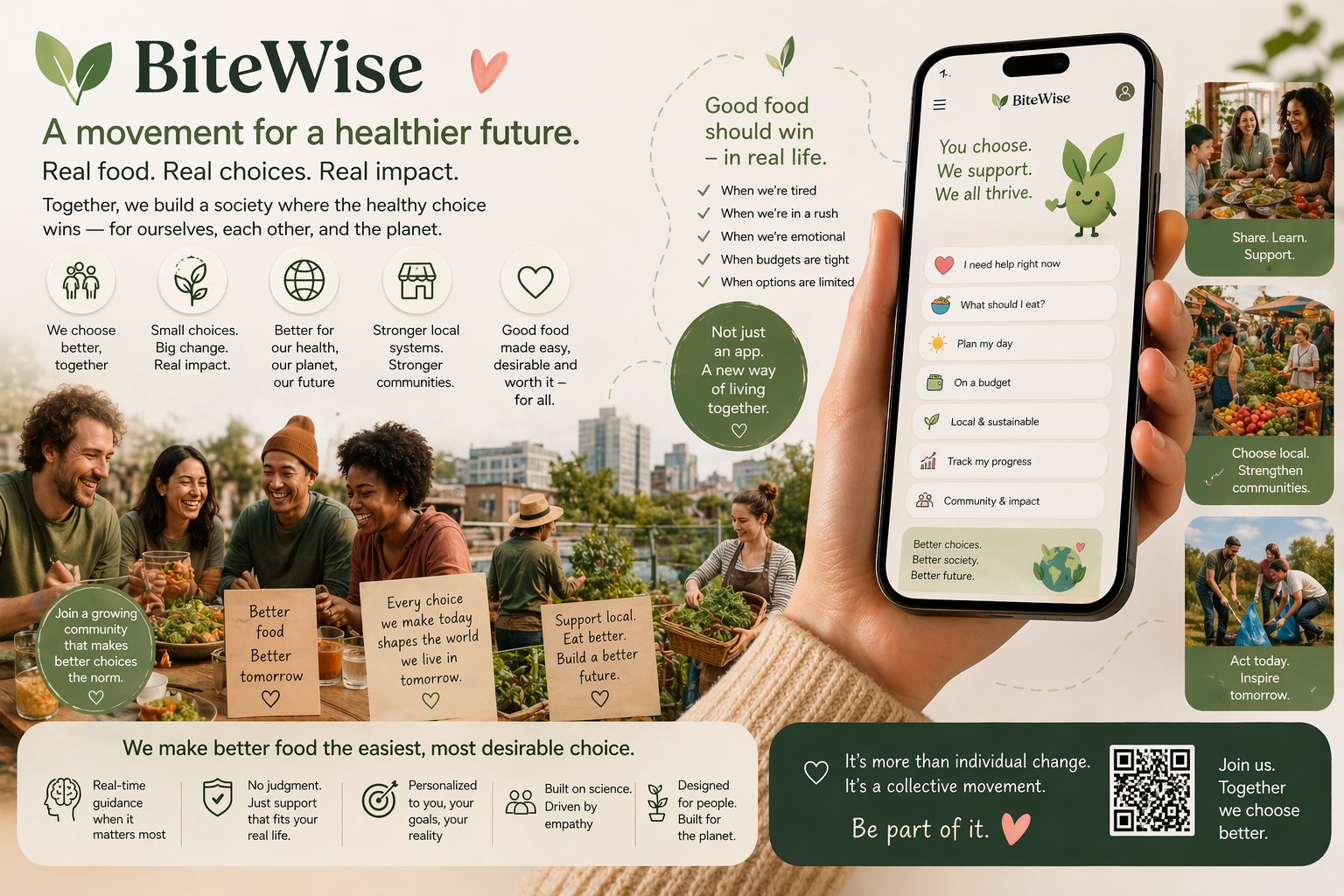
Short description
BiteWise is a judgment‑free AI coach that helps people relearn conscious eating and build lifelong healthy habits. Instead of prescribing diets, it analyses how users currently eat and provides real‑time guidance on the impact of their choices. It suggests small, gradual adjustments that improve health while preserving the joy of eating
Contact person for the project
don't have one yet
Giulia Jagan
giuliajagan@gmail.com
9230 Flawil
Detailed description
What deeper problem are you addressing?
People are not short of nutritional information; they struggle to apply it when it counts. Eating decisions are emotional and contextual, made under stress, fatigue and cravings.
Prescriptive diets and calorie tracking treat eating as a rational problem, leading to guilt and inconsistency.
. The real barrier is the gap between knowledge and in‑the‑moment behaviour. BiteWise shifts from instruction to understanding: it interprets individual habits, explains the impact of choices and promotes small, achievable adjustments, helping users make better decisions in real time and supporting lasting change.
Which habits or practices do you want to change — and how?
Replace reactive, emotionally driven eating with intentional decisions that fit real‑life constraints. Today choices default to what is easy, fast, cheap or comforting. . BiteWise meets users at these decision moments and offers simple, personalised guidance to navigate trade‑offs and find healthier options within their budget and time. By focusing on small, realistic adjustments rather than radical change, these choices become repeatable habits, shifting behaviour from reactive to sustainable without requiring perfection.
Who will benefit — and how could your idea create impact beyond this project?
BiteWise directly supports individuals who struggle to maintain healthy eating habits, particularly during life transitions or periods of stress.
By making better choices easier and more desirable in everyday situations, it aims to shift demand toward healthier, more sustainable food. This behavioural layer can complement public‑health and community programmes by translating knowledge into adoption. .Over time, these small improvements could reduce healthcare pressures and contribute to cultural norms where healthier choices are natural. The idea sprang from personal experience during pregnancy, when immediate, non‑judgemental guidance proved more useful than fragmented advice.
Has the idea already been tested — and if so, what did you learn?
We have informally tested the concept by using AI tools for guidance during cravings, meal selection and supplement timing. Immediate, contextual support proved far more effective than static advice, and a non‑judgemental, flexible tone kept users engaged. The ability to incorporate personal preferences and dietary approaches made the experience feel relevant.
What do you want to work on during the booster — and what do you want to find out?
During the booster, the goal is to design and test a Proof of Concept (POC) of the AI coach, focusing on real-time interaction and core use cases such as cravings, meal decisions, and recovery moments.
The POC will be tested with clearly defined user groups, including individuals in life transitions (e.g. (during/after) pregnancy, going through an important weight loss program, etc..), professionals under stress, and health-conscious users who struggle with consistency.
This includes developing a simple, functional prototype, testing it in real-life situations, and defining the core features for an MVP based on observed behavior and feedback.
The key assumptions to validate could include:
1. Users will actively engage with the AI in the moment of decision (not only retrospectively or passively)
2. Users are willing to share real, imperfect eating behavior with an AI in a non-judgmental context
3. Real-time, adaptive guidance leads to different choices than users would have made alone
4. Small, suggested adjustments (rather than strict rules) are perceived as actionable and worth following.
The main objective is to understand whether this approach becomes a natural part of users’ daily routines and meaningfully influences their behavior over time
What is your most important learning goal — and how would you know if you need to change course?
The most important learning goal is to validate the key assumptions outlined in the previous phase, particularly whether users engage with the AI in real-life decision moments and whether this interaction does eventually influences their behavior in a consistent and sustainable manner.
For instance, if users do not actively use the tool during key moments (e.g. cravings or meal decisions), or if the interaction does not influence their choices, it would indicate that the real-time companion model might not be sufficiently valuable or intuitive.
In that case, the approach would need to be reconsidered. User feedback would be closely analyzed to identify whether there are overlooked opportunities, alternative user segments, or specific needs that require a different interaction model or value proposition.
To ensure reliable insights, user interviews will be designed with open-ended questions, allowing participants to express genuine experiences and feedback rather than being guided toward expected answers.
Who are your concrete test partners?
Initial testing will be conducted with a small group of users within my personal and professional network, including individuals currently experiencing life transitions (e.g. pregnancy, new parents) and professionals under high stress.
I am currently identifying potential partners in the health and wellness space, such as nutritionists, pregnancy support groups, and community health initiatives, to enable more structured testing.
It would be valuable to receive support in connecting with relevant organizations that can provide access to diverse user groups and real-world testing environments.
What do you hope to get from the booster?
The main goal is to validate and refine the concept in a structured, real-world setting.
In particular, access to relevant partners in the health and wellness space—such as nutrition experts, pregnancy support groups, and community health initiatives—would be highly valuable to test the solution with diverse user groups.
Expert input in behavioral science and nutrition would further strengthen the approach and ensure scientific grounding, although initial contacts have already been identified.
As the project is currently developed independently, the opportunity to connect with potential co-founders through the program would also be valuable to strengthen the team and support further development.
Finally, connections to investors or organizations interested in supporting or participating in the initiative as early partners would be beneficial for the next stage of growth.
Who is on your team — and what is each person's or organisation's role?
The project is currently led by myself, with a background in Product Management, Interaction Design, and AI-driven product development (including a strong experience in vibecoding). I am responsible for business and product development, design, as well as the prototyping and testing phase
At this stage, I am supported informally by advisors with complementary expertise. Their input contributes to refining the product direction and grounding the concept in real-world use cases.
As the project evolves, there is potential for these collaborators to take on a more formal role, depending on the development and opportunities identified.
Who do you need as an expert to further develop your idea?
To further develop the idea, collaboration with accredited experts in nutrition and behavioral science would be essential to strengthen the scientific foundation and credibility of the approach.
In particular, formal collaboration with an established institution or certified professionals would help validate the methodology, ensure alignment with current research, and support long-term positioning within the health and prevention space.
Additionally, expertise in AI system design and personalization would support the development of a robust and scalable interaction model. At the same time, I have the necessary competencies to develop a functional prototype with sufficient technical and AI performance to test the core concept (POC) and assess its potential.