

What deeper problem are you addressing?
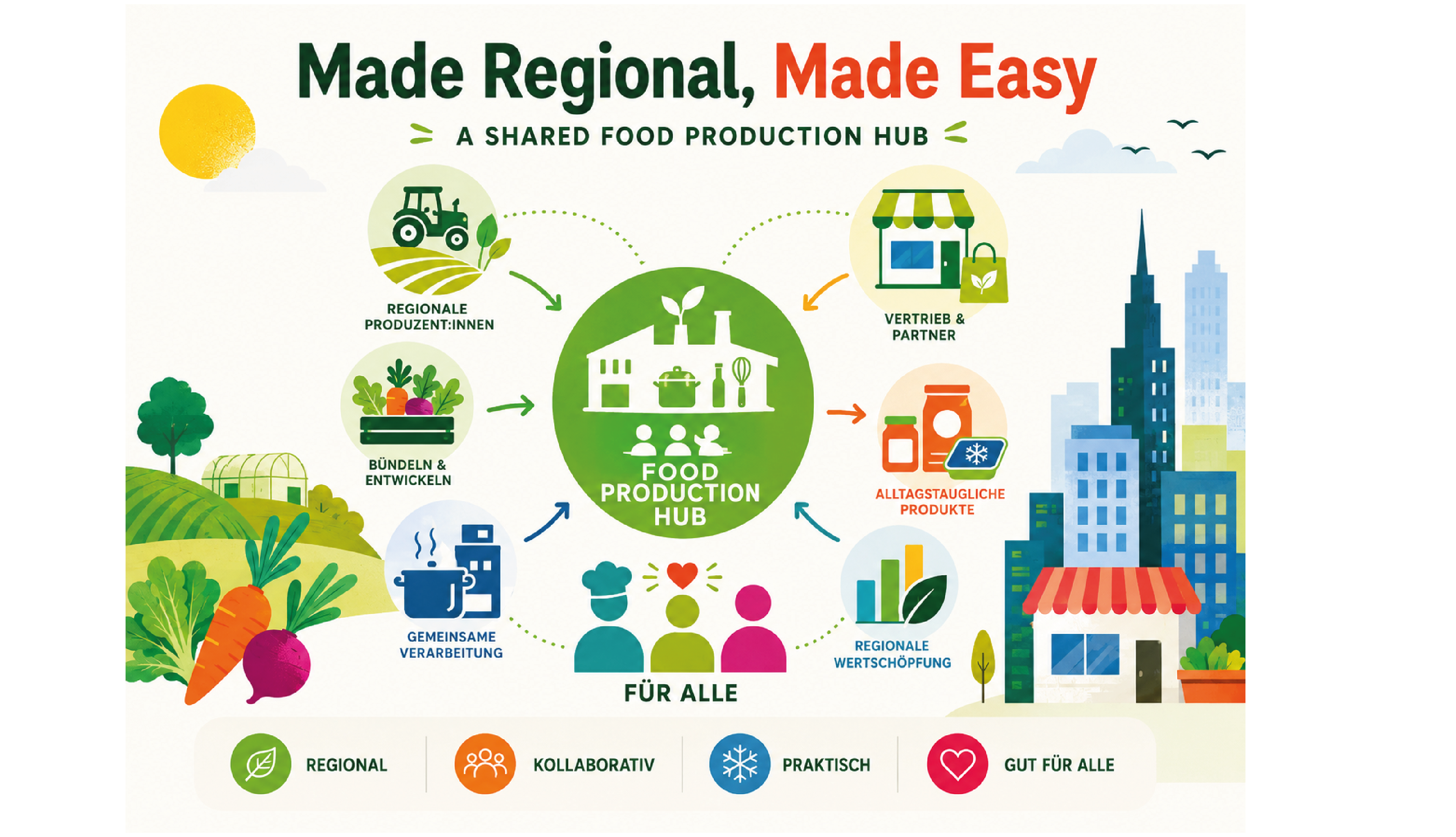
We address a structural infrastructure gap in regional food systems: between regional production and urban demand, there is a lack of a professional, shared intermediary structure that bundles raw materials, processes them and translates them into everyday, ready-to-use products.
Many regional producers, gastronomy actors and food initiatives have high-quality raw materials, recipes, strong local networks and good ideas. What they often lack are suitable infrastructure, resources and competences to produce efficiently, in compliance with food regulations and at consistent quality, as well as logistics and access to stable sales channels – especially at medium scale, between small-scale production and industrial scaling.
As a result, regional food is available, but often remains too irregular, too labour-intensive or too expensive for everyday use. Professional kitchens, shops and households need forms that make use easy: washed, cut or pre-processed fresh produce, prepared components, ready-to-cook products or frozen meals. Without this intermediate layer, regional products remain a niche, while industrial standard offers are cheaper, more convenient and more reliably available.
Our hypothesis is that regional food systems can reach broader markets if processing, product development and distribution are organised as shared infrastructure. A socially oriented production enterprise contributes production capacity, staff and know-how. Network organizations such as Genuss aus Stadt und Land and Lebensmittel Netzwerk Basel connect producers, raw materials, gastronomy, community catering and sales channels. Regional shops such as Bioflix enable market tests and access to sales channels. Basel Food Factory coordinates the collaboration; the Institute for Management (FHNW) accompanies the research and learning process with a focus on governance, economic viability, pricing, margin distribution and the organisational design of shared value creation.The Food Production Hub
Which habits or practices do you want to change — and how?
We want to change the practice that regional food only becomes part of everyday life when consumers, cooks, shops or institutions are willing to make additional efforts. Today, regional food often means more coordination, more preparation, smaller quantities, irregular availability and higher prices.
Our approach follows the logic of the call: make regional food more convenient – and make convenience food better. The Hub translates regional raw materials into different levels of convenience: ready-to-use fresh products for community catering and gastronomy, prepared or ready-to-cook products for regional shops, and frozen meals or meal components for everyday use.
This changes practices on several levels: producers can reach new markets without building their own infrastructure; shops receive a more reliable regional assortment; gastronomy and community catering can integrate regional food more easily into professional workflows; and consumers gain better access to regional, transparent and everyday-ready products. Community catering is particularly important because it reaches people regardless of income, prior knowledge or shopping behaviour.
What do you want to work on during the booster — and what do you want to find out?
During the booster, we want to test the Food Production Hub as a shared regional processing and collaboration model. Three application paths serve as real test fields:
- ready-to-use fresh products for community catering and gastronomy
- prepared or ready-to-cook products for regional shops
- frozen meals or meal components for everyday use
The central research question is: How must collaboration between producers, processing partners, shops, gastronomy, community catering and network organisations be structured so that regional convenience products can be produced, priced and distributed in a way that is economically viable, transparent and fair for all actors involved?
We will examine this question through concrete test products. For each product, we will analyse the value chain, production costs, pricing logic, margin distribution, roles and responsibilities, decision-making processes and economic effects for the actors involved. We want to find out which governance principles, pricing mechanisms and partnership structures are needed for shared infrastructure to become a viable model for regional food systems.