

Foto: Stadt Zürich
The heat of the 2026 summer was exceptional - but will not be an exception going forward. Swiss cities are not built for the intensity and length of heat waves we are increasingly facing. The consequences include excess mortality and disease affecting both the human and the non-human population, social isolation, and damage to green (e.g., trees and parks), grey (e.g., rails and pavement), and blue (e.g., groundwater reservoirs, ponds) infrastructures. The Swiss Cities Association is now calling for heat protection to be treated as a national responsibility, just like flood protection.
The technical solutions at the adaptation level are well known: unsealing, shading, greening, air conditioning and climate shelters, and warning systems. But a heat-resilient city cannot be built one government agency at a time, nor through measures alone. In fact we see heat resilience as a coordination problem - as well as a question of social practices and societal cohesion.
With this call, we are looking forward to identifying the challenges with the highest urgency and lever, and to co-create and test ideas that tackle these challenges: How can we enable the public in finding and implementing complementary solutions from their needs and capacities—thereby giving people the opportunity to take collective action to protect and support their fellow humans and ecologies?
And on an institutional level: How can we ensure that measures are implemented with the key risk owners and affected people – and sustained with commitment that lasts? What is needed for interventions such as climate shelters and climate buddies to be adopted and utilised, and reach those most vulnerable?
We are looking for social innovations, new partnerships and societal interventions. To beat the heat, our cities need to grow. Into a network of relationships, areas of responsibility, and shared accountability, in which public and private services are just one part—alongside neighbourhoods, cooperatives, businesses, property management companies, associations, and the built and natural environment.
Whether you work in a city department, run a cooperative or neighbourhood centre – or simply know your neighbourhood: your experience helps us find the right challenges.
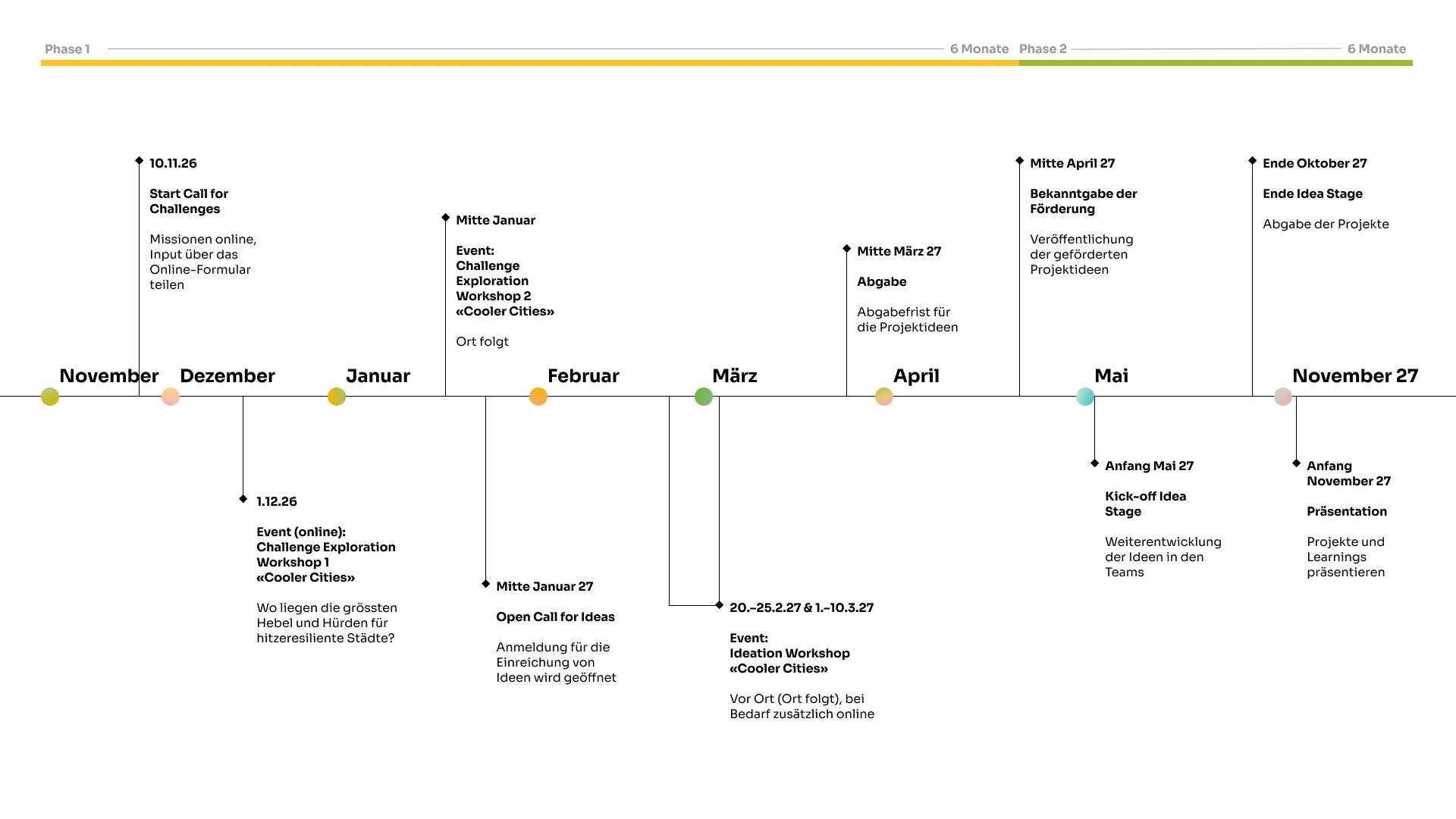
Before looking for solutions, we want to understand the key opportunities and barriers. Together with experts from practice, research, public administration, economy and civil society, we want to build a shared understanding of the problem and formulate a set of clear, actionable challenges that can become the starting point for new solutions.
There are two ways to contribute to shaping the challenge: you can register your interest in joining an online Challenge Exploration Workshop, or already share your input through this form.
Take part and you can submit. Participating in one of the workshops qualifies you to submit a project idea and thus to apply for funding of up to CHF 22,500. So come along, even if your idea isn't finished yet.

Where are the biggest levers and obstacles for heat-resilient cities and communities? In this online workshop, we jointly sharpen the challenges of the “Cooler Cities” mission. Your perspective from practice, research, government, business or civil society feeds directly into our 2027 Call for Ideas.
📅 1 December 2026, 3:00 to 4:30 pm · 📍 Online
Register